You’ve spent decades pouring your life, energy, and capital into building a successful enterprise. Now, as you look toward retirement, a new venture, or simply dynamic liquidity, the question shifts from "How do I run this?" to "How do I sell my business online and capture its true maximum value?" For business owners aged 45 to 65, this transition is profoundly significant. It represents the culmination of a career. It is the moment when abstract "equity" must become tangible wealth that secures your family’s future or funds your next chapter. The challenge, however, is that the landscape for selling a $1M to $40M revenue business has fundamentally changed. The process is no longer local; it is digital, global, and exceptionally competitive. You feel the pressure because the stakes are incredibly high. The marketplace is crowded. Confidentiality is paramount. Reaching the right vetted acquirers requires sophisticated precision. This is not just a transaction; it's your legacy. A.E. Business Brokers specializes in navigating this complex path for established owners like you. In this 2026 guide, we outline the exact roadmap you need to transition from CEO to a successful exit, leveraging online reach while maintaining ironclad confidentiality.

In 2026, the market for private business acquisitions has matured, prioritizing verified, high-performing assets over speculation. Data indicates that online visibility is now mandatory for attracting a diverse pool of competitive buyers, including strategic acquirers, private equity groups, and family offices, who rely on sophisticated digital screening. Private equity, for instance, has record levels of "dry powder" and is actively seeking established companies with $1M+ EBITDA. The market rewards transparency and pre-packaged diligence. According to recent reports, well-prepared businesses with optimized financial reporting are seeing multiples sustain or increase, particularly in sectors like SaaS, healthcare, and advanced manufacturing. Conversely, businesses that lack recurring revenue or have high customer concentration face pricing pressure. The key to capturing the premium valuation is not simply listing your business "for sale" online, but rather engineered visibility to a curated group of vetted buyers.
| Metric | 2026 Data Point | Source |
|---|---|---|
| Average EBITDA Multiple (Lower M&A Market) | 4.8× - 7.5× (Industry Dependent) | BizBuySell / William & Wall |
| Median Days to Close (Lower M&A Market) | 185 Days (Pre-Vetted) | William & Wall Analysis |
| Percentage of Deals Using SBA Financing | ~60% of Deals under $5M Sale Price | SBA.gov Data |
If you are exploring a sale in the next 0-6 months, your first crucial step is obtaining a professional valuation. This is not a guess; it is a data-driven analysis. When you request a valuation from A.E. Business Brokers, the initial process is simple: you provide basic information (name, email, phone, and standard revenue/EBITDA figures). Within one business day, an experienced broker will respond. We will schedule a confidential, 30-45 minute discovery call to understand your goals and review your high-level numbers. Before any detailed documents are exchanged, we will provide a mutual Non-Disclosure Agreement (NDA) to protect your privacy. For enterprises with revenue exceeding $5M, you will be personally connected with a senior partner or managing director specializing in complex M&A. The agenda for this initial call focuses on clarifying the directional valuation range, reviewing the optimal sale timeline, and outlining the necessary steps to prepare your financial data. This disclaimer is vital: this preliminary value is an estimated range based on comparable market data, not a final guarantee. Most importantly, you maintain total control; you decide if and when to proceed.
In the market for high-value enterprises, buyers do not pay for potential; they pay for verified performance and risk mitigation. When trying to sell my business online, we engineered your exit by focusing on the eight key drivers that maximize valuation multiples.
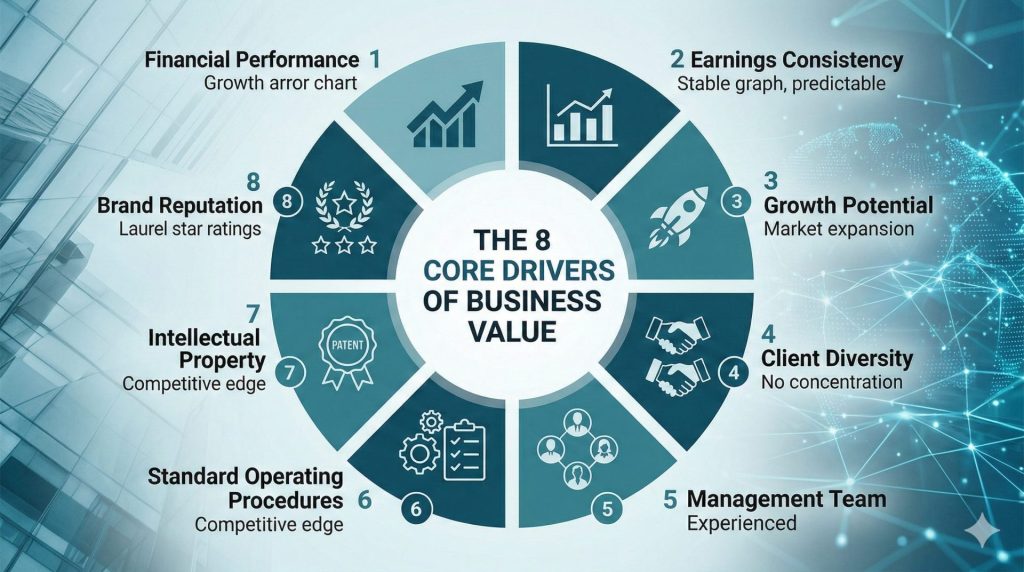
This is the cornerstone. Acquirers are buying your future cash flow. They analyze 3-5 years of clean, consistent earnings, focusing heavily on EBITDA (Earnings Before Interest, Taxes, Depreciation, and Amortization). A consistent or growing EBITDA margin signals a healthy, efficient operation. Any significant "add-backs" (owner's salary, personal expenses, one-time costs) must be meticulously documented and defensible.
Revenue quality matters. Contractual recurring revenue (subscriptions, long-term service contracts) is valued significantly higher than sporadic, transactional revenue. Buyers love high retention rates and low churn. If your model isn’t recurring, we work to identify the "predictable" elements—like a loyal customer base with a high repeat-purchase rate—that provide a similar layer of security for the new owner.
High concentration is a major risk factor that compresses multiples. If a single customer accounts for more than 15-20% of your revenue, buyers see vulnerability. We analyze your customer mix. The healthiest businesses have a diverse client base where no single entity holds undue leverage, guaranteeing that the business will not collapse if one key relationship ends.
If the business relies entirely on you to function, it is less valuable. A robust, experienced management team that can operate the company successfully without your daily involvement is a massive value driver. We highlight the strength of your leadership, documentation of roles, and employee retention strategies, demonstrating that the business is an "institutionalized asset" rather than just your personal job.
Why must customers buy from you instead of a competitor? Your competitive advantage is your "moat." This might be proprietary technology, exclusive contracts, high barriers to entry, a unique geographic lock, or powerful intellectual property (patents, trademarks). A strong moat protects your margins and makes future cash flows more defensive and, thus, more valuable.
A buyer wants to step into a well-oiled machine, not a chaotic puzzle. Comprehensive, documented SOPs for every critical function—sales, marketing, fulfillment, HR, and accounting—are essential. This systems-driven approach reduces the perceived operational risk of transition, proving to the acquirer that the business is scalable and its success can be replicated without you.
While buyers value current cash flow, they pay a premium for growth potential. Where is the next 2x, 5x, or 10x growth coming from? We meticulously outline tangible growth opportunities—such as market expansion, new product lines, digital optimization, or strategic acquisitions—allowing the acquirer to visualize their ROI. You need a clear, defensible growth story.
Finally, your intangible market presence is powerful. We evaluate your brand equity, online reputation (reviews, ratings), customer goodwill, and overall market share. A recognized, trusted brand name with strong customer loyalty reduces a new owner’s customer acquisition cost and commands higher margins than an unknown competitor.

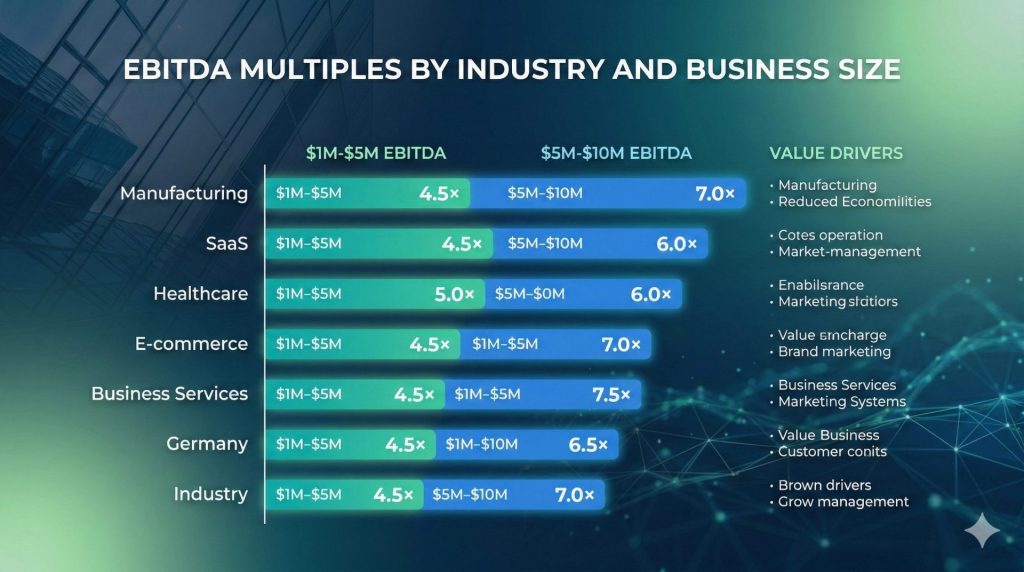
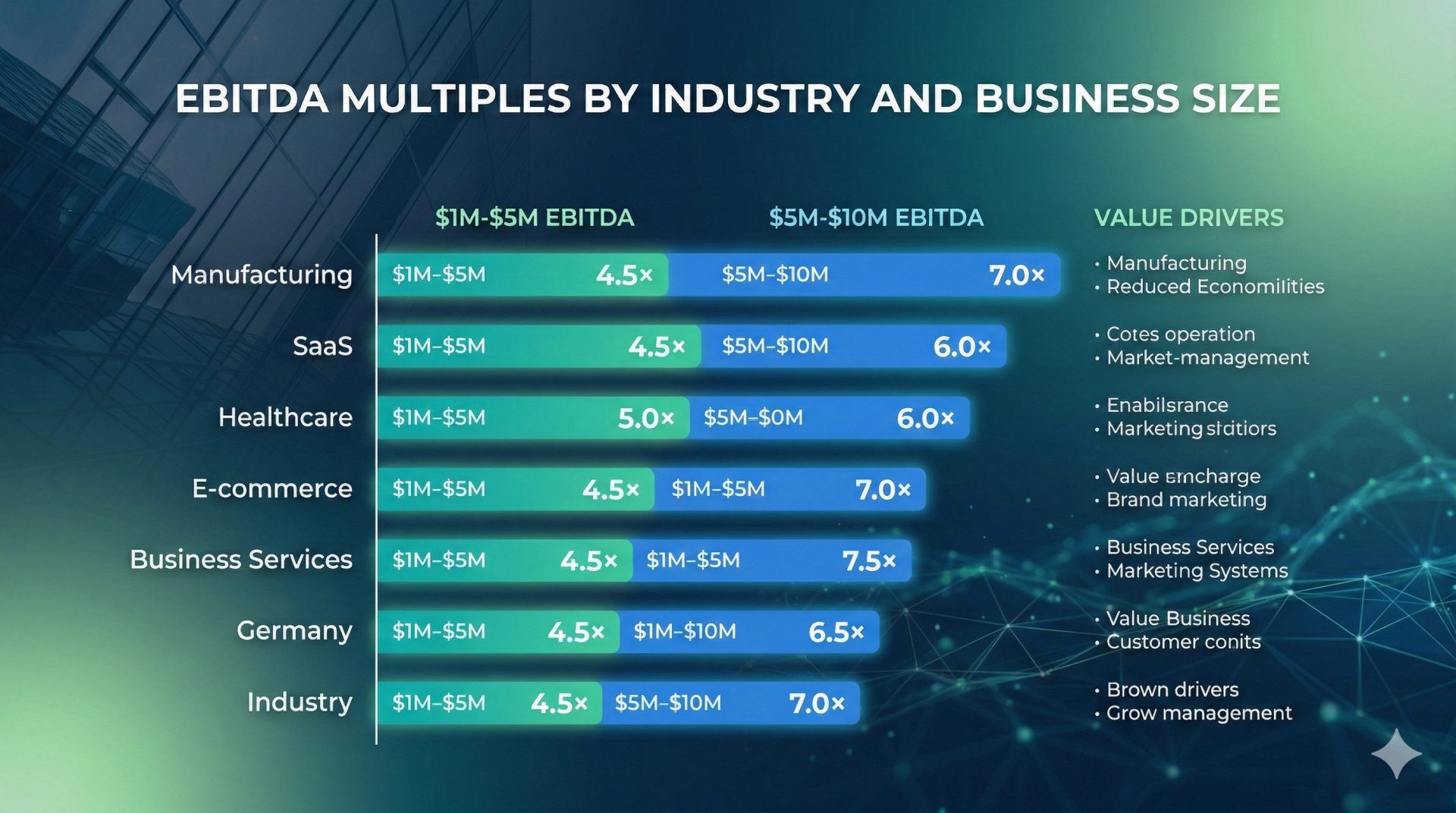
| Industry | $1M-$5M EBITDA | $5M-$10M EBITDA | Key Value Drivers |
|---|---|---|---|
| Advanced Manufacturing | 4.5-6.5× | 6.0-8.0× | IP, specialized equipment, customer lock-in. |
| B2B Services / Consulting | 4.0-5.5× | 5.0-7.0× | Recurring contracts, low churn, strong team. |
| Healthcare / Medical Practices | 4.0-6.0× | 5.5-7.5×+ | Regulatory compliance, private pay %, patient retention. |
| Technology / SaaS | 5.0-8.0× | 7.0-10.0×+ | MRR/ARR growth, low churn, scalable platform, IP. |
| E-commerce & Digital Brands | 3.5-5.5× | 5.0-7.0× | Brand equity, customer LTV, optimized supply chain. |
| Construction & Skilled Trades | 3.5-5.0× | 4.5-6.0× | Backlog of contracts, asset value, licensed team. |
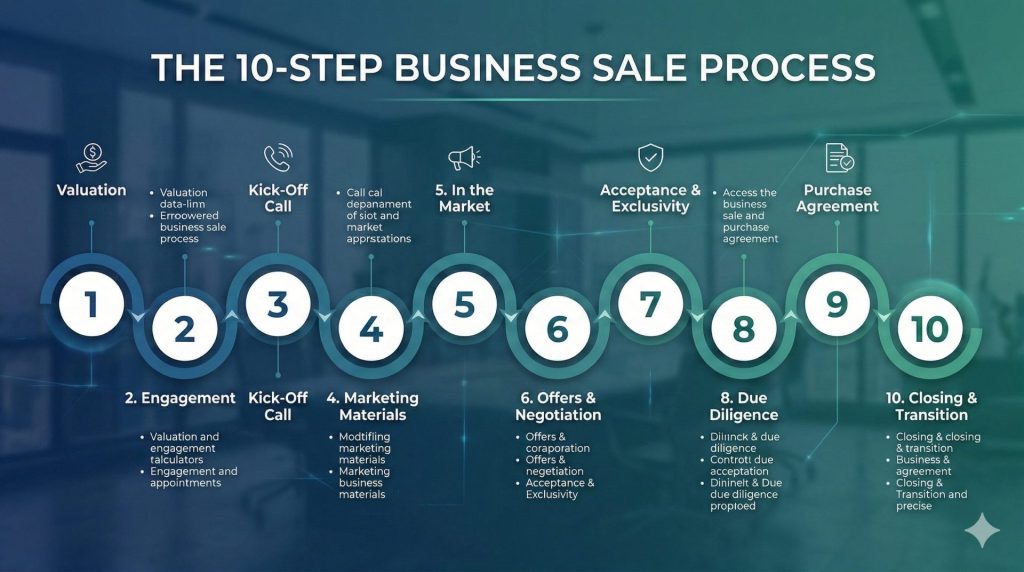
Successfully selling a business—especially when aiming to sell your business online—requires an engineered, competitive process that protects confidentiality. We manage this entire lifecycle to minimize disruption to your operations and maximize your final exit value.
For a business of your size ($1M-$40M revenue), navigating this process alone is exceptionally high-risk. A business broker’s commission is a performance-based fee, typically paid only upon a successful closing. We are worth the investment because our engineered process consistently delivers a final net value that far exceeds the cost of our services. Our value is proven in six key areas: we manage confidentiality (essential for your customers and employees); we accurately value the business using multiple data points; we vet every buyer before they see any sensitive data; we create a competitive bidding environment that maximizes your multiple; we expertly navigate the complex due diligence and legal hurdles; and most importantly, we allow you to continue running your business, ensuring its value doesn't drop during the sale.
It is not only possible but increasingly mandatory for mid-market businesses. Buyers are global and sophisticated; they use proprietary digital networks and data platforms to scan and source acquisitions. We don't just "post" your business on a generic directory. We leverage a data-driven, engineered online strategy to identify and directly target institutional buyers, private equity groups, and strategic acquirers globally who are actively seeking acquisitions in your exact revenue bracket. This creates a curated, private marketplace that maximizes valuation while maintaining confidentiality.
The standard timeline for a $1M-$40M revenue business typically ranges from 6 to 11 months, with the median closing occurring in about 7-8 months. This depends heavily on several factors: the quality of your financial records (pre-vetted is faster), your industry's current demand (tech is faster), and how quickly you respond during due diligence. Preparing well in advance can shave 60-90 days off the process. Our 10-step method is designed to maximize efficiency and momentum once the business is in the market, pushing the timeline toward the faster end of the average.
This is a top priority for mid-market owners aged 45-65. When trying to sell my business online, we employ a multi-layered security protocol. We require an NDA from every single buyer *before* any identifying information is released. We market your business using a "blind" teaser profile that hides your company name, location, and identifiable details. Competitive data is only released to thoroughly vetted acquirers in a secure, controlled data room (CIM phase). This process allows you to maintain normal operations without disruption.
Historically, "business brokers" focused on main street businesses (restaurants, local retail), while "M&A (Mergers & Acquisitions) advisors" managed larger corporate transactions ($10M+). However, in 2026, the roles blur. Mid-market firms like A.E. Business Brokers operate at this intersection. We bring M&A sophistication—financial recasting, strategic CIMs, targeted PE lists, and complex deal structuring—to the $1M to $40M market. We combine high-level advisor expertise with the focused energy of a broker dedicated to achieving your retirement goals.
Absolutely. A business broker manages the competitive process, sources the buyers, values the business, and negotiates the deal terms. We are not a CPA or a law firm. You need a specialized CPA to assist with Recasting your financials and analyzing the tax implications of the deal structure. You need a specialized business attorney to draft the binding definitive legal documents (APA or SPA) and ensure your assets are protected. We collaborate closely with your deal team (broker, CPA, and attorney) to drive the deal forward effectively.
No, listing it on public business-for-sale websites is only a passive component of a much larger strategy for a mid-market company. We create a competitive market by engineering visibility to three distinct buckets of acquirers: 1. **Strategic Buyers:** Other companies in or adjacent to your industry that seek synergies. 2. **Financial Buyers:** Private equity firms or family offices looking for platform companies or bolt-on acquisitions. 3. **High Net Worth Individuals:** Qualified professionals seeking substantial investments. We actively reach out to this curated audience through our proprietary network, direct-to-buyer outreach, and specialized online channels.
To successfully navigate the sell my business online process, you must provide 3-5 years of detailed financial history. Buyers analyze this "recasted" performance. This includes detailed Profit & Loss statements (P&Ls), Balance Sheets, and your corporate federal Tax Returns. We recast these statements to add back non-cash expenses (depreciation) and owner-specific costs (salary, non-business perks) to determine the true EBITDA (Earnings Before Interest, Taxes, Depreciation, and Amortization). This recasted figure is what drives your business’s valuation multiple.
For mid-market enterprises, it is very rare to "walk away" at closing. Acquirers are buying cash flow that you generate, and they need confidence that it will continue without you. You should expect to commit to a structured transition period. This often involves a handover of 30 to 180 days included in the sale price. However, many private equity or strategic deals require the owner to "stay on" as a consultant or key leader for 1 to 3 years to ensure operational continuity. We negotiate these transition agreements to fit your retirement goals.
An add-back is any expense that is necessary for you as the current owner, but that a future owner would not incur. Common defensible examples include depreciation, amortization, interest on loans, your (market rate) salary, and non-business expenses like your car lease or family health insurance run through the company. We recast your financials to clearly isolate these expenses. Add-backs are defensible if they are clearly supported by evidence. Buyers will meticulously verify every dollar of add-backs during due diligence, so meticulous documentation is essential.
The single most common reason a deal collapses is a discovery made during the **due diligence** phase. Deals fall apart when a buyer uncovers significant financial discrepancies, inaccurate data, hidden legal liabilities, major environmental issues, key customer attrition, or problems with key supplier contracts. A transaction often dies not because the valuation was wrong, but because the verified data didn’t match the story presented in the marketing materials. This is why we focus heavily on preparing our clients and verifying data before ever going to market.
This depends on your specific strategy and industry. For main street businesses, listing a price is common. For the $1M-$40M revenue market, we often employ a structured "No Asking Price" approach. In this model, we create a CIM that outlines the Recasted financial performance and the growth potential, inviting qualified buyers to submit their Letters of Intent with their best overall valuation and deal structure. This dynamic bidding environment allows the market to compete, frequently driving the final price above what you might have originally set.
You can structure the deal to meet your exact financial and emotional goals. While many transactions are 100% "asset sales" or "stock sales," mid-market exits often involve a "majority recapitalization." In this structure, you sell a majority of the company (e.g., 60-80%) to a buyer, usually a private equity firm, and retain the remaining minority stake. This is often called a "second bite of the apple." It provides immediate liquidity today while allowing you to participate financially in the subsequent growth and next successful exit.


Unlock a free premium market valuation provided by the nation’s leading brokerage. With our 30-year track record, $2 billion in transactions, and a global team of 25+ experts, we find your ideal buyer in under 4 months, often above market value

