You’ve spent decades pouring your life, energy, and capital into building a successful enterprise. Now, as you look toward retirement, a new venture, or simply dynamic liquidity, the question shifts from "How do I run this?" to "How do I sell my business online and capture its true maximum value?" For business owners aged 45 to 65, this transition is profoundly significant. It represents the culmination of a career. It is the moment when abstract "equity" must become tangible wealth that secures your family’s future or funds your next chapter. The challenge, however, is that the landscape for selling a $1M to $40M revenue business has fundamentally changed. The process is no longer local; it is digital, global, and exceptionally competitive. You feel the pressure because the stakes are incredibly high. The marketplace is crowded. Confidentiality is paramount. Reaching the right vetted acquirers requires sophisticated precision. This is not just a transaction; it's your legacy. A.E. Business Brokers specializes in navigating this complex path for established owners like you. In this 2026 guide, we outline the exact roadmap you need to transition from CEO to a successful exit, leveraging online reach while maintaining ironclad confidentiality.

In 2026, the market for private business acquisitions has matured, prioritizing verified, high-performing assets over speculation. Data indicates that online visibility is now mandatory for attracting a diverse pool of competitive buyers, including strategic acquirers, private equity groups, and family offices, who rely on sophisticated digital screening. Private equity, for instance, has record levels of "dry powder" and is actively seeking established companies with $1M+ EBITDA. The market rewards transparency and pre-packaged diligence. According to recent reports, well-prepared businesses with optimized financial reporting are seeing multiples sustain or increase, particularly in sectors like SaaS, healthcare, and advanced manufacturing. Conversely, businesses that lack recurring revenue or have high customer concentration face pricing pressure. The key to capturing the premium valuation is not simply listing your business "for sale" online, but rather engineered visibility to a curated group of vetted buyers.
| Metric | 2026 Data Point | Source |
|---|---|---|
| Average EBITDA Multiple (Lower M&A Market) | 4.8× - 7.5× (Industry Dependent) | BizBuySell / William & Wall |
| Median Days to Close (Lower M&A Market) | 185 Days (Pre-Vetted) | William & Wall Analysis |
| Percentage of Deals Using SBA Financing | ~60% of Deals under $5M Sale Price | SBA.gov Data |
If you are exploring a sale in the next 0-6 months, your first crucial step is obtaining a professional valuation. This is not a guess; it is a data-driven analysis. When you request a valuation from A.E. Business Brokers, the initial process is simple: you provide basic information (name, email, phone, and standard revenue/EBITDA figures). Within one business day, an experienced broker will respond. We will schedule a confidential, 30-45 minute discovery call to understand your goals and review your high-level numbers. Before any detailed documents are exchanged, we will provide a mutual Non-Disclosure Agreement (NDA) to protect your privacy. For enterprises with revenue exceeding $5M, you will be personally connected with a senior partner or managing director specializing in complex M&A. The agenda for this initial call focuses on clarifying the directional valuation range, reviewing the optimal sale timeline, and outlining the necessary steps to prepare your financial data. This disclaimer is vital: this preliminary value is an estimated range based on comparable market data, not a final guarantee. Most importantly, you maintain total control; you decide if and when to proceed.
In the market for high-value enterprises, buyers do not pay for potential; they pay for verified performance and risk mitigation. When trying to sell my business online, we engineered your exit by focusing on the eight key drivers that maximize valuation multiples.
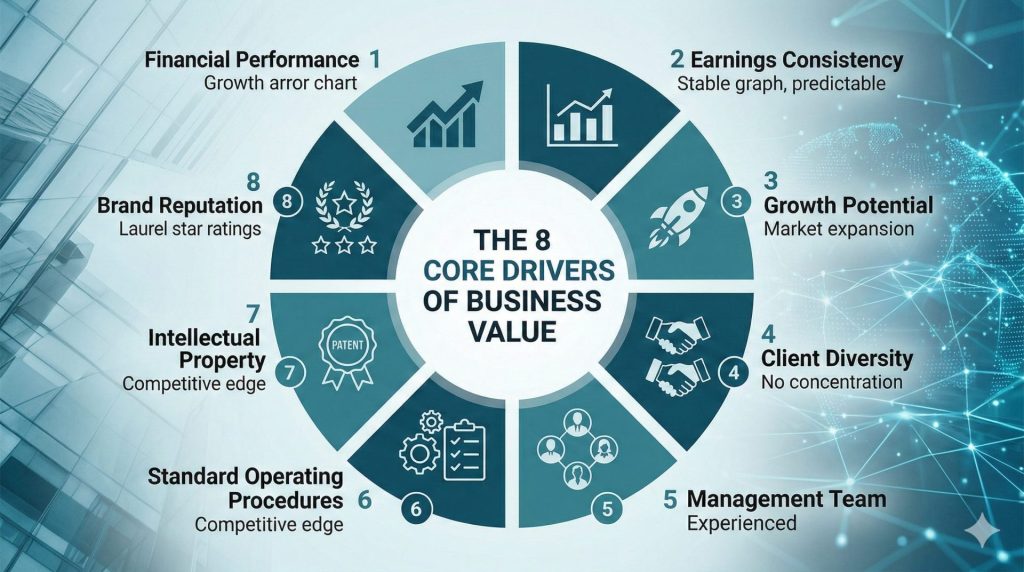
This is the cornerstone. Acquirers are buying your future cash flow. They analyze 3-5 years of clean, consistent earnings, focusing heavily on EBITDA (Earnings Before Interest, Taxes, Depreciation, and Amortization). A consistent or growing EBITDA margin signals a healthy, efficient operation. Any significant "add-backs" (owner's salary, personal expenses, one-time costs) must be meticulously documented and defensible.
Revenue quality matters. Contractual recurring revenue (subscriptions, long-term service contracts) is valued significantly higher than sporadic, transactional revenue. Buyers love high retention rates and low churn. If your model isn’t recurring, we work to identify the "predictable" elements—like a loyal customer base with a high repeat-purchase rate—that provide a similar layer of security for the new owner.
High concentration is a major risk factor that compresses multiples. If a single customer accounts for more than 15-20% of your revenue, buyers see vulnerability. We analyze your customer mix. The healthiest businesses have a diverse client base where no single entity holds undue leverage, guaranteeing that the business will not collapse if one key relationship ends.
If the business relies entirely on you to function, it is less valuable. A robust, experienced management team that can operate the company successfully without your daily involvement is a massive value driver. We highlight the strength of your leadership, documentation of roles, and employee retention strategies, demonstrating that the business is an "institutionalized asset" rather than just your personal job.
Why must customers buy from you instead of a competitor? Your competitive advantage is your "moat." This might be proprietary technology, exclusive contracts, high barriers to entry, a unique geographic lock, or powerful intellectual property (patents, trademarks). A strong moat protects your margins and makes future cash flows more defensive and, thus, more valuable.
A buyer wants to step into a well-oiled machine, not a chaotic puzzle. Comprehensive, documented SOPs for every critical function—sales, marketing, fulfillment, HR, and accounting—are essential. This systems-driven approach reduces the perceived operational risk of transition, proving to the acquirer that the business is scalable and its success can be replicated without you.
While buyers value current cash flow, they pay a premium for growth potential. Where is the next 2x, 5x, or 10x growth coming from? We meticulously outline tangible growth opportunities—such as market expansion, new product lines, digital optimization, or strategic acquisitions—allowing the acquirer to visualize their ROI. You need a clear, defensible growth story.
Finally, your intangible market presence is powerful. We evaluate your brand equity, online reputation (reviews, ratings), customer goodwill, and overall market share. A recognized, trusted brand name with strong customer loyalty reduces a new owner’s customer acquisition cost and commands higher margins than an unknown competitor.

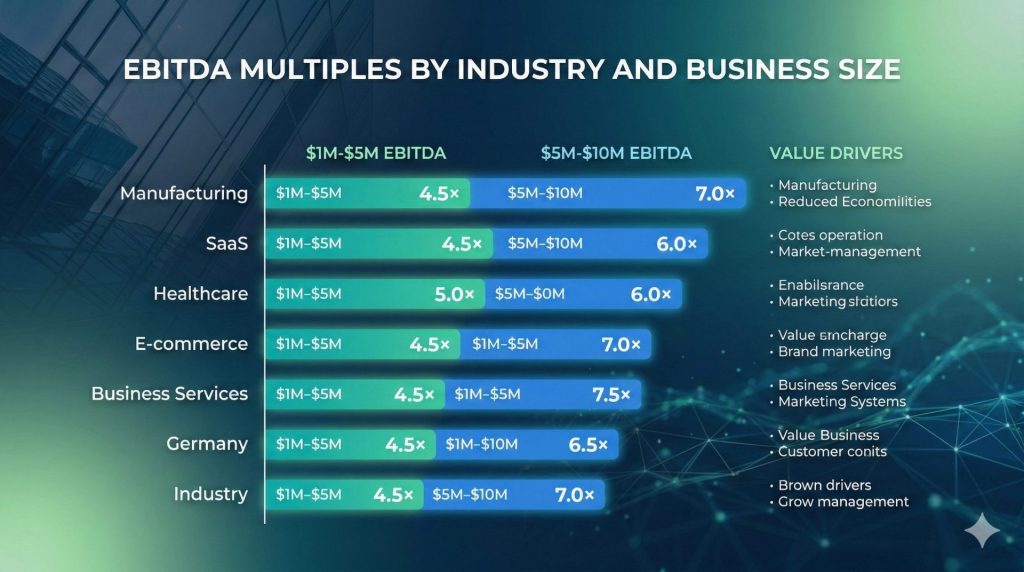
| Industry | $1M-$5M EBITDA | $5M-$10M EBITDA | Key Value Drivers |
|---|---|---|---|
| Advanced Manufacturing | 4.5-6.5× | 6.0-8.0× | IP, specialized equipment, customer lock-in. |
| B2B Services / Consulting | 4.0-5.5× | 5.0-7.0× | Recurring contracts, low churn, strong team. |
| Healthcare / Medical Practices | 4.0-6.0× | 5.5-7.5×+ | Regulatory compliance, private pay %, patient retention. |
| Technology / SaaS | 5.0-8.0× | 7.0-10.0×+ | MRR/ARR growth, low churn, scalable platform, IP. |
| E-commerce & Digital Brands | 3.5-5.5× | 5.0-7.0× | Brand equity, customer LTV, optimized supply chain. |
| Construction & Skilled Trades | 3.5-5.0× | 4.5-6.0× | Backlog of contracts, asset value, licensed team. |
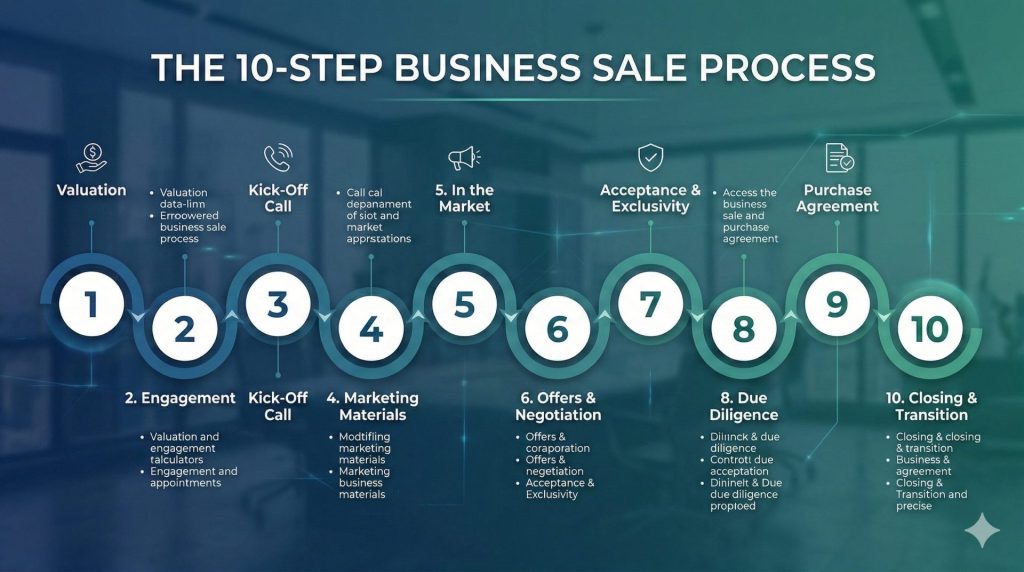
Successfully selling a business—especially when aiming to sell your business online—requires an engineered, competitive process that protects confidentiality. We manage this entire lifecycle to minimize disruption to your operations and maximize your final exit value.
For a business of your size ($1M-$40M revenue), navigating this process alone is exceptionally high-risk. A business broker’s commission is a performance-based fee, typically paid only upon a successful closing. We are worth the investment because our engineered process consistently delivers a final net value that far exceeds the cost of our services. Our value is proven in six key areas: we manage confidentiality (essential for your customers and employees); we accurately value the business using multiple data points; we vet every buyer before they see any sensitive data; we create a competitive bidding environment that maximizes your multiple; we expertly navigate the complex due diligence and legal hurdles; and most importantly, we allow you to continue running your business, ensuring its value doesn't drop during the sale.
It is not only possible but increasingly mandatory for mid-market businesses. Buyers are global and sophisticated; they use proprietary digital networks and data platforms to scan and source acquisitions. We don't just "post" your business on a generic directory. We leverage a data-driven, engineered online strategy to identify and directly target institutional buyers, private equity groups, and strategic acquirers globally who are actively seeking acquisitions in your exact revenue bracket. This creates a curated, private marketplace that maximizes valuation while maintaining confidentiality.
The standard timeline for a $1M-$40M revenue business typically ranges from 6 to 11 months, with the median closing occurring in about 7-8 months. This depends heavily on several factors: the quality of your financial records (pre-vetted is faster), your industry's current demand (tech is faster), and how quickly you respond during due diligence. Preparing well in advance can shave 60-90 days off the process. Our 10-step method is designed to maximize efficiency and momentum once the business is in the market, pushing the timeline toward the faster end of the average.
This is a top priority for mid-market owners aged 45-65. When trying to sell my business online, we employ a multi-layered security protocol. We require an NDA from every single buyer *before* any identifying information is released. We market your business using a "blind" teaser profile that hides your company name, location, and identifiable details. Competitive data is only released to thoroughly vetted acquirers in a secure, controlled data room (CIM phase). This process allows you to maintain normal operations without disruption.
Historically, "business brokers" focused on main street businesses (restaurants, local retail), while "M&A (Mergers & Acquisitions) advisors" managed larger corporate transactions ($10M+). However, in 2026, the roles blur. Mid-market firms like A.E. Business Brokers operate at this intersection. We bring M&A sophistication—financial recasting, strategic CIMs, targeted PE lists, and complex deal structuring—to the $1M to $40M market. We combine high-level advisor expertise with the focused energy of a broker dedicated to achieving your retirement goals.
Absolutely. A business broker manages the competitive process, sources the buyers, values the business, and negotiates the deal terms. We are not a CPA or a law firm. You need a specialized CPA to assist with Recasting your financials and analyzing the tax implications of the deal structure. You need a specialized business attorney to draft the binding definitive legal documents (APA or SPA) and ensure your assets are protected. We collaborate closely with your deal team (broker, CPA, and attorney) to drive the deal forward effectively.
No, listing it on public business-for-sale websites is only a passive component of a much larger strategy for a mid-market company. We create a competitive market by engineering visibility to three distinct buckets of acquirers: 1. **Strategic Buyers:** Other companies in or adjacent to your industry that seek synergies. 2. **Financial Buyers:** Private equity firms or family offices looking for platform companies or bolt-on acquisitions. 3. **High Net Worth Individuals:** Qualified professionals seeking substantial investments. We actively reach out to this curated audience through our proprietary network, direct-to-buyer outreach, and specialized online channels.
To successfully navigate the sell my business online process, you must provide 3-5 years of detailed financial history. Buyers analyze this "recasted" performance. This includes detailed Profit & Loss statements (P&Ls), Balance Sheets, and your corporate federal Tax Returns. We recast these statements to add back non-cash expenses (depreciation) and owner-specific costs (salary, non-business perks) to determine the true EBITDA (Earnings Before Interest, Taxes, Depreciation, and Amortization). This recasted figure is what drives your business’s valuation multiple.
For mid-market enterprises, it is very rare to "walk away" at closing. Acquirers are buying cash flow that you generate, and they need confidence that it will continue without you. You should expect to commit to a structured transition period. This often involves a handover of 30 to 180 days included in the sale price. However, many private equity or strategic deals require the owner to "stay on" as a consultant or key leader for 1 to 3 years to ensure operational continuity. We negotiate these transition agreements to fit your retirement goals.
An add-back is any expense that is necessary for you as the current owner, but that a future owner would not incur. Common defensible examples include depreciation, amortization, interest on loans, your (market rate) salary, and non-business expenses like your car lease or family health insurance run through the company. We recast your financials to clearly isolate these expenses. Add-backs are defensible if they are clearly supported by evidence. Buyers will meticulously verify every dollar of add-backs during due diligence, so meticulous documentation is essential.
The single most common reason a deal collapses is a discovery made during the **due diligence** phase. Deals fall apart when a buyer uncovers significant financial discrepancies, inaccurate data, hidden legal liabilities, major environmental issues, key customer attrition, or problems with key supplier contracts. A transaction often dies not because the valuation was wrong, but because the verified data didn’t match the story presented in the marketing materials. This is why we focus heavily on preparing our clients and verifying data before ever going to market.
This depends on your specific strategy and industry. For main street businesses, listing a price is common. For the $1M-$40M revenue market, we often employ a structured "No Asking Price" approach. In this model, we create a CIM that outlines the Recasted financial performance and the growth potential, inviting qualified buyers to submit their Letters of Intent with their best overall valuation and deal structure. This dynamic bidding environment allows the market to compete, frequently driving the final price above what you might have originally set.
You can structure the deal to meet your exact financial and emotional goals. While many transactions are 100% "asset sales" or "stock sales," mid-market exits often involve a "majority recapitalization." In this structure, you sell a majority of the company (e.g., 60-80%) to a buyer, usually a private equity firm, and retain the remaining minority stake. This is often called a "second bite of the apple." It provides immediate liquidity today while allowing you to participate financially in the subsequent growth and next successful exit.
Average Price of Business for Sale in California: Complete 2026 Guide | AE Business Brokers
If you have spent the last decade building a business with $1 million to $40 million in annual revenue, you already know that California rewards the bold. You have navigated rising labor costs, shifting regulations, and relentless competition — and you have come out ahead. Now, as you begin exploring an exit, you deserve the same level of rigor and market intelligence you applied to building the business in the first place. The single most important number on the table is the average price of business for sale in California, and understanding it could be the difference between a life-changing payday and leaving millions behind.
According to BizBuySell's 2025 Year in Review, the national median sale price for small businesses rose 2% to $350,000, with total enterprise value across all transactions reaching $7.95 billion — up 3% year-over-year. California, ranked the second most active state by buyer interest, consistently commands a 15–25% premium over national benchmarks due to its diverse economy and robust acquisition capital. For mid-market owners in the $1M–$40M revenue band, that translates to enterprise values typically ranging from $2 million to over $15 million, depending on industry, profitability, and deal structure.
Averages only tell part of the story. Your business has unique financials, a distinct competitive position, and intangible value that a database median will never capture. That is why partnering with a specialist matters. A.E. Business Brokers works exclusively with California mid-market owners, applying proven valuation methodologies, a curated buyer network, and confidential transaction management to maximize what you take home at closing. This guide gives you the data framework you need — and the context to act on it intelligently.
📷 IMAGE PLACEHOLDER 1

Before we dive into the numbers, consider whether these statements describe where you are today:
If even three of those statements resonate, you are in the right place. Let's start with the market data.
The California business-for-sale market enters 2026 on solid footing. Nationally, BizBuySell reported 9,586 closed transactions in 2025, with median cash flow of $158,950 and median revenue of $703,000 among sold businesses. The average cash flow multiple ticked up 1% to 2.61x, and 94% of listed asking prices were achieved at closing — a figure that underscores strong buyer demand for well-priced, well-documented businesses.
In California specifically, buyer interest is second only to Florida nationally, and the market for businesses in the $2M–$20M enterprise value range is particularly active heading into 2026. Broker sentiment is notably optimistic: 61% of brokers nationally expect stronger buyer demand, while 72% anticipate more owners coming to market driven by Baby Boomer retirements. Nearly half of brokers (49%) report that Boomers already make up the majority of their listings — which means competition for buyer attention is increasing and preparation matters more than ever.
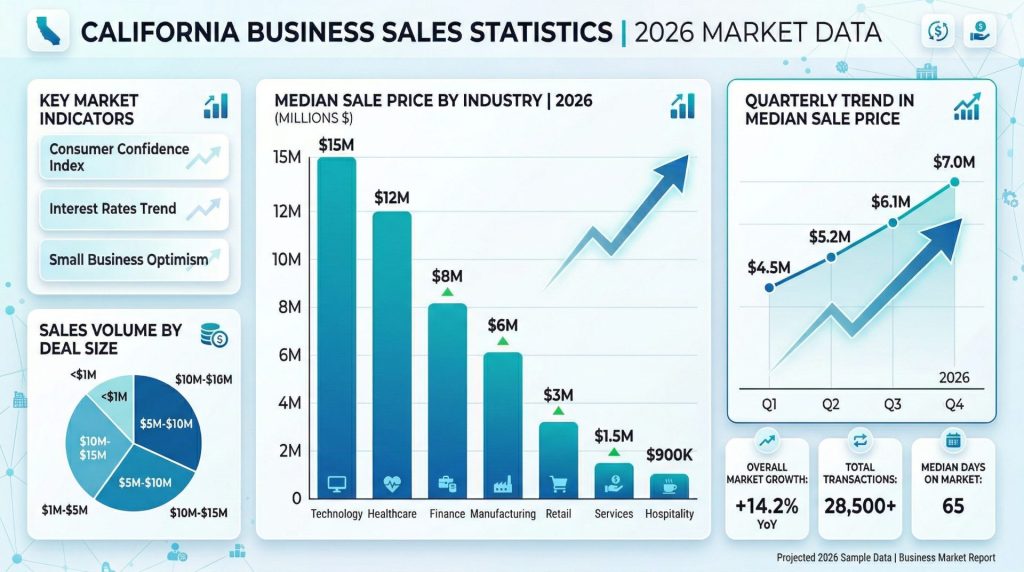
Filename: average-price-business-for-sale-california-market-data.png
| Metric | National (2025) | California Est. (2025) | YoY Change |
|---|---|---|---|
| Median Sale Price (all sizes) | $350,000 | $415,000–$440,000 | +2% |
| Median Sale Price – Manufacturing | $650,000 | $720,000–$850,000 | -7% |
| Median Sale Price – Service | $340,000 | $390,000–$480,000 | +5% |
| Median Sale Price – Retail | $250,000 | $290,000–$360,000 | -2% |
| Median Sale Price – Restaurant | $225,000 | $260,000–$320,000 | Flat |
| Average Cash Flow Multiple | 2.61x | 2.8x–3.2x | +1% |
| Average Revenue Multiple | 0.69x | 0.75x–0.90x | +2% |
| Median Days to Close | 170 days | 165–185 days | +4 days |
| Sale/Asking Price Ratio | 94% | 93%–96% | +1% |
Sources: BizBuySell 2025 Year in Review; BizBuySell Insight Report Q4 2025; California estimates based on regional market premium analysis.
No two businesses sell for the same price, even in the same industry and geography. Understanding the eight levers that buyers analyze allows you to proactively strengthen your position — and your valuation — before going to market.
📷 IMAGE PLACEHOLDER 3
Filename: average-price-business-for-sale-california-valuation-factors.png
Alt text: Infographic showing 8 key factors that determine the average price of business for sale in California including EBITDA and growth
Download URL: https://www.genspark.ai/api/files/s/vuAvrf1v?cache_control=3600
Buyers pay for where your business is going, not just where it stands today. A company showing consistent 10–15% annual revenue growth over three years commands a meaningfully higher multiple than an identically profitable business with flat top-line performance. In California's competitive M&A environment, growth trajectory can expand your EBITDA multiple by 0.5x to 1.5x above industry benchmarks. Document your growth drivers clearly — new customers, expanded territories, new service lines, or pricing power — and prepare a compelling narrative backed by clean historical data before going to market.
EBITDA — Earnings Before Interest, Taxes, Depreciation, and Amortization — is the core engine of business valuation. California businesses in the $1M–$40M revenue range typically sell at 3x to 7x normalized EBITDA, depending on sector and size. Recurring, predictable profitability driven by structural advantages commands far higher prices than lumpy project-based income. Work with your financial advisor 12–18 months before going to market to normalize your financials. Per First Page Sage's 2025 EBITDA research, businesses with strong recurring revenue can see multiples 20–40% above non-recurring peers.
If one customer represents more than 20% of your revenue, most sophisticated buyers will reduce their offer price or build a significant escrow holdback into the deal. Customer concentration is one of the most common deal-killers in mid-market California transactions. The goal is a diversified revenue base where no single customer accounts for more than 15% of total revenue. Consider pre-sale initiatives — new customer acquisition, multi-year contract conversions — to broaden your base before engaging a broker. The payoff in final sale price can be substantial, often multiples of the cost to address it.
Your sector establishes a baseline multiple; your competitive position within that sector determines whether you trade above or below it. California technology and healthcare businesses routinely trade at 4x–8x EBITDA, while food service and retail businesses more typically land in the 2x–3.5x range. Being the market leader in a defensible niche, holding proprietary technology, operating under long-term contracts, or maintaining certifications that create barriers to entry can each push your multiple meaningfully higher. Buyers pay for durability — ensure your marketing materials communicate your competitive moat explicitly and persuasively.
Owner dependence is one of the most consistent value destroyers in a business sale. If the business cannot function without you, buyers will price that risk into their offer. A business with a capable, tenured management team that operates independently commands a premium of 0.5x to 1.5x over comparable owner-dependent businesses. Start delegating critical functions 12–24 months before you plan to sell. Document processes, build accountable org structures, and demonstrate that the business's success is institutionalized — not personalized. This counterintuitive investment can add hundreds of thousands of dollars to your final price.
Predictability commands a premium in every M&A market. Businesses with subscription revenue, long-term service contracts, maintenance agreements, or membership models sell for higher multiples than those dependent on transactional sales. According to First Page Sage valuation data, recurring-revenue businesses achieve EBITDA multiples 25–35% higher than non-recurring peers in the same industry. Document contract terms, renewal rates, and average lifetime value clearly in your data room. Even modest recurring revenue components can shift buyer perception — and pricing — significantly.
Sophisticated buyers purchase a platform for future growth — not just current cash flow. If your business operates in an expanding market or has untapped geographic territories, your business becomes significantly more attractive. Frame your growth narrative with specificity: "We currently serve only the Bay Area but our model is replicable in Los Angeles, San Diego, and Phoenix" outperforms vague promises of "significant upside." Per BizBuySell data, 33% of buyers view AI-enabled businesses as more valuable — positioning technology adoption as a growth accelerant in your story can meaningfully strengthen valuation.
In California's high-cost real estate environment, lease terms have an outsized effect on business value. A business under a favorable long-term lease in a prime California market has embedded real estate value that buyers can quantify. Conversely, a lease expiring in 12 months or a facility requiring significant capital expenditure creates deal risk and price pressure. Ensure your lease has at least 3–5 years of remaining term with extension options before entering the market. Negotiate a lease extension proactively — it is one of the most tangible and straightforward ways to reduce perceived deal risk and protect your headline valuation.
The table below shows typical EBITDA multiple ranges for California businesses in the $1M–$40M revenue segment. Multiples vary based on company size, growth rate, customer concentration, and deal structure. Larger businesses within each category typically trade at the higher end of the range. Data synthesized from First Page Sage EBITDA research, BizBuySell 2025 transaction data, and regional California comparables.
📷 IMAGE PLACEHOLDER 4
Filename: average-price-business-for-sale-california-ebitda-multiples.png
Alt text: Horizontal bar chart showing EBITDA multiples by industry for businesses for sale in California ranging from 2x to 8x
Download URL: https://www.genspark.ai/api/files/s/glxbz1UT?cache_control=3600
| Industry | EBITDA Multiple Range | Key Value Driver | 2026 Trend |
|---|---|---|---|
| Technology / SaaS | 4.0x – 8.5x | Recurring revenue, ARR growth | ↑ Rising |
| Healthcare Services | 3.5x – 6.0x | Reimbursement contracts, defensible niche | ↑ Rising |
| Manufacturing | 3.0x – 5.5x | Proprietary IP, government contracts | ↓ Declining |
| Distribution / Logistics | 3.0x – 5.5x | Long-term client contracts, route density | → Stable |
| Professional Services | 2.5x – 5.0x | Recurring retainers, client tenure | ↑ Rising |
| Construction & Contracting | 2.0x – 4.5x | Backlog, recurring maintenance contracts | → Stable |
| Retail (Specialty/Niche) | 2.0x – 3.5x | Brand loyalty, e-commerce integration | ↓ Slight decline |
| Food & Beverage / Restaurant | 1.8x – 3.0x | Brand, location, multi-unit scalability | → Flat |
Understanding the average price of business for sale in California is only half the equation. Executing a professional sale process is what converts that potential value into actual proceeds at closing.
📷 IMAGE PLACEHOLDER 5
Filename: average-price-business-for-sale-california-sale-process.png
Alt text: 10-step timeline infographic for selling a business in California showing the complete process from valuation to closing
Download URL: https://www.genspark.ai/api/files/s/CpbQVrRt?cache_control=3600
📷 IMAGE PLACEHOLDER 6
Filename: average-price-business-for-sale-california-broker-checklist.png
Alt text: Broker value checklist infographic showing protection mechanisms for California business sellers including confidentiality and negotiation
Download URL: https://www.genspark.ai/api/files/s/PANXhYxX?cache_control=3600
Selling without professional representation — or with the wrong advisor — is one of the most expensive decisions a California business owner can make. Research consistently shows that businesses sold through experienced, specialized brokers achieve 20–35% higher net proceeds than owner-direct transactions. For a business with $3 million in EBITDA, that delta represents $600,000 to over $1 million in additional proceeds — multiples of any reasonable brokerage fee.
A.E. Business Brokers provides a comprehensive suite of protections: strict confidentiality protocols that safeguard your workforce and customer relationships, rigorous buyer qualification before any sensitive information is shared, access to a curated network of PE and strategic buyers actively seeking California acquisitions, expert deal structuring to optimize after-tax proceeds, and experienced negotiation to prevent the re-trades and price erosion that plague poorly managed sale processes.
📷 IMAGE PLACEHOLDER 7
Filename: average-price-business-for-sale-california-broker-benefits.png
Alt text: Infographic highlighting key benefits of using AE Business Brokers to sell a California business including higher sale price and faster closing
Download URL: https://www.genspark.ai/api/files/s/IGuoHSev?cache_control=3600
The average price of a business for sale in California varies significantly by size, industry, and profitability. California's median sits approximately 15–25% above the national median of $350,000, placing the state's broad estimate between $415,000 and $440,000 for all-size businesses. For mid-market businesses with $1M–$40M in revenue, California enterprise values typically range from $2 million to $15 million or more, depending on EBITDA margins, industry multiples, and deal structure. Contact A.E. Business Brokers for a confidential, data-driven valuation specific to your business.
Most mid-market California businesses are valued using a multiple of EBITDA or SDE (Seller's Discretionary Earnings) for smaller businesses. The multiple applied depends on your industry, revenue size, growth trajectory, customer concentration, and recurring cash flow quality. Revenue multiples (typically 0.5x–2x revenue) are used as a cross-check. Specialized sectors like technology may use ARR-based metrics. A professional business broker provides a normalized financial recast and a defensible valuation range that buyers and their advisors cannot easily challenge. Starting this process 12–18 months before your target exit date is strongly recommended.
The national median was 170 days per BizBuySell's 2025 data. In California's mid-market, well-prepared businesses with clean financials and experienced representation typically close in 6–9 months from engagement. Complex transactions involving real estate, multiple entities, or PE buyers can take 10–14 months. Underp█
Only 20-30% of businesses that go to market actually sell successfully—a sobering statistic that most business owners don't discover until they've already engaged a broker and invested months into the sales process. After more than 30 years of selling businesses across the United States marketplace, we've witnessed firsthand why 70-80% of business sales fail to close, and we've compiled this comprehensive resource to help owners understand the real data behind business sale success rates, timelines, valuations, and buyer behavior.
This page contains 171 verified business sale statistics drawn from authoritative industry sources including the International Business Brokers Association (IBBA) Market Pulse Reports, BizBuySell transaction data, Pepperdine University's Private Capital Markets research, U.S. Small Business Administration lending data, and proprietary M&A advisory reports. Each statistic includes full source citations and explanations of what the data means for business owners planning an exit.
What you'll find in this guide:
Unlike generic business-for-sale articles that recycle the same handful of statistics, this resource provides granular, actionable data organized by business size, industry, geography, and deal structure. Whether you're a business owner preparing for exit, a buyer evaluating acquisition opportunities, an M&A advisor benchmarking deal terms, or a researcher seeking credible business transaction data, these statistics offer the most comprehensive view of the U.S. business sale market available in a single resource.
Our methodology: Data has been compiled from Q1 2024 through Q4 2025, with historical comparisons dating back to 2019 where relevant. We've prioritized statistics from recurring industry surveys (IBBA Market Pulse, BizBuySell Insight Reports) to ensure data consistency and reliability. Where multiple sources report conflicting figures, we've noted the variance and cited the most recent or methodologically rigorous source. All statistics are updated quarterly to reflect the latest market conditions.
Why business sale success rates matter: Understanding that only 2-3 out of every 10 businesses successfully sell fundamentally changes how owners should approach exit planning. The data reveals that businesses with realistic valuations, clean financials, advance preparation (ideally 2-3 years), and professional representation have success rates exceeding 60%—more than double the market average. This guide shows you exactly what separates successful exits from failed listings.
<figure class="wp-block-image aligncenter size-large <script> // Comprehensive image protection for all chart images document.addEventListener('DOMContentLoaded', function() { Find - targeting YOUR specific var = document.querySelectorAll('img[src*="Business-Sale"], img[src*="chart"], img[src*="ebitda"], img[src*="buyer"], img[src*="valuation"], img[src*="multiples"], img[src*="fee"], img[src*="EBITDA"], img[src*="Chart"], img.protected-chart-image, img[src*="/wp-content/uploads/2026/02/"]'); images.forEach(function(img) Disable right-click img.addEventListener('contextmenu', function(e) e.preventDefault(); showProtectionAlert(); return false; }); drag img.addEventListener('dragstart', Add attributes img.setAttribute('oncontextmenu', 'return false;'); img.setAttribute('ondragstart', img.style.pointerEvents 'none'; img.style.userSelect img.style.webkitUserSelect img.style.webkitTouchCallout Wrap in a protective div if (!img.parentElement.classList.contains('image-protection-wrapper')) wrapper document.createElement('div'); wrapper.className 'image-protection-wrapper'; wrapper.style.position 'relative'; wrapper.style.display 'inline-block'; wrapper.style.width '100%'; wrapper.style.maxWidth img.width ? + 'px' : img.parentNode.insertBefore(wrapper, img); wrapper.appendChild(img); invisible overlay overlay.className 'image-protection-overlay'; overlay.style.position 'absolute'; overlay.style.top '0'; overlay.style.left overlay.style.width overlay.style.height overlay.style.zIndex '10'; overlay.style.cursor 'not-allowed'; overlay.style.background 'transparent'; overlay.addEventListener('contextmenu', overlay.addEventListener('click', wrapper.appendChild(overlay); } Show alert function showProtectionAlert() alertBox document.getElementById('imageProtectionAlert'); (!alertBox) alertBox.id 'imageProtectionAlert'; alertBox.innerHTML ` <div style="position: fixed; top: 50%; left: transform: translate(-50%, -50%); background: white; padding: 30px; border-radius: 10px; box-shadow: 0 4px 20px rgba(0,0,0,0.3); z-index: 99999; max-width: 500px; width: 90%; border: 3px solid #dc3545;"> <h3 style="margin: 15px 0; color: #dc3545; font-size: 20px; font-weight: 700;">🔒 Image Protected</h3> <p line-height: 1.6; #333; 15px;"> This is protected to ensure proper attribution. Please use the <strong>"Get Embed Code"</strong> button below share it with automatic source credit. </p> 13px; #666; 1.5;"> Proper attribution helps maintain quality and reliability of business statistics online supports our research efforts. <button onclick="document.getElementById('imageProtectionAlert').remove();" style="padding: 12px 25px; #0066CC; none; 5px; cursor: pointer; 600; 15px; 100%;"> ✓ Got It Me Code </button> </div> 100%; height: rgba(0,0,0,0.6); 99998; backdrop-filter: blur(2px);"></div> `; document.body.appendChild(alertBox); Scroll nearest embed setTimeout(function() embedButtons document.querySelectorAll('[id*="embedBtn"]'); (embedButtons.length > 0) embedButtons[0].scrollIntoView({ behavior: 'smooth', block: 'center' }, 500); Auto-close after 10 seconds (alertBox && document.body.contains(alertBox)) alertBox.remove(); 10000); print screen (partially) document.addEventListener('keyup', (e.key === 'PrintScreen' || e.keyCode 44) navigator.clipboard.writeText(''); common keyboard shortcuts saving document.addEventListener('keydown', Ctrl+S or Cmd+S (Save) ((e.ctrlKey e.metaKey) e.key 's') Ctrl+C Cmd+C on area 'c') selection window.getSelection(); (selection selection.anchorNode) parent selection.anchorNode.parentElement; (parent parent.closest('.image-protection-wrapper')) </script> <style> /* CSS */ Target by filename pattern img[src*="Business-Sale"], img[src*="business-sale"], img[src*="/2026/02/"], img[src*="Buyer"], img[src*="Valuation"], img[src*="Multiples"], img[src*="Fee"], img.protected-chart-image pointer-events: none !important; user-select: -webkit-user-select: -moz-user-select: -ms-user-select: -webkit-touch-callout: -webkit-user-drag: -moz-user-drag: user-drag: Wrapper .image-protection-wrapper position: relative; display: inline-block; Overlay .image-protection-overlay absolute; 10; not-allowed; transparent; containers .chart-embed-section, .chart-section, .reference-table-section, [class*="wp-block-image"] Mobile-specific @media (max-width: 768px) Prevent dragging globally img[src*="Business-Sale"]::before, img[src*="/2026/02/"]::before content: ''; 5;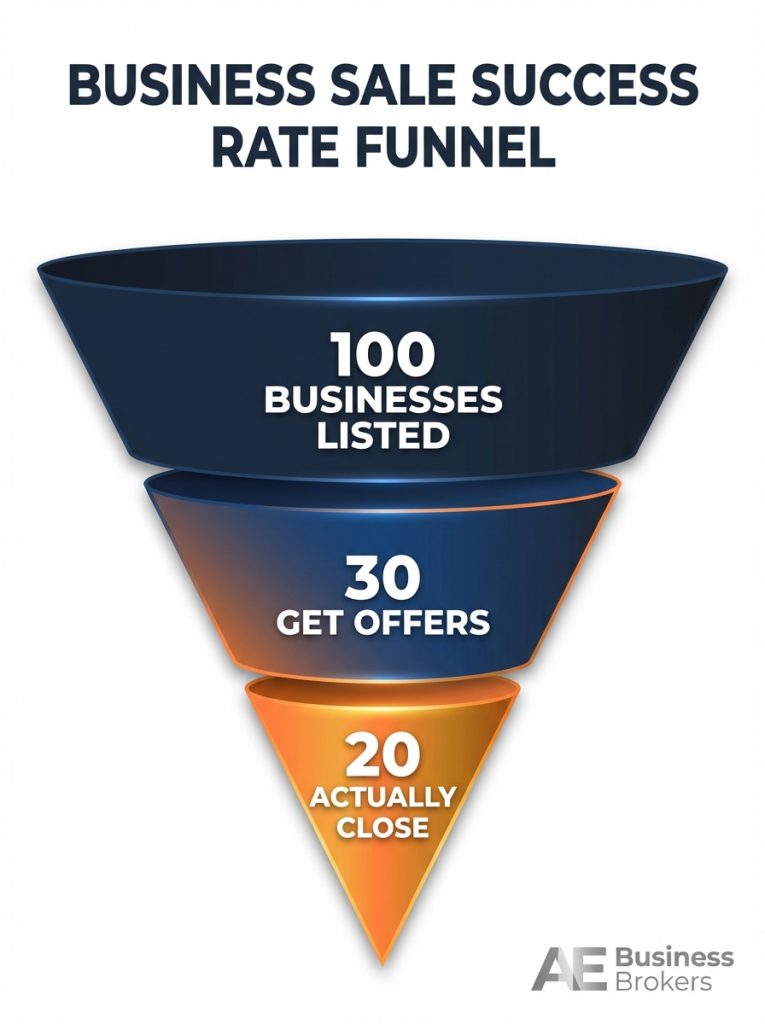
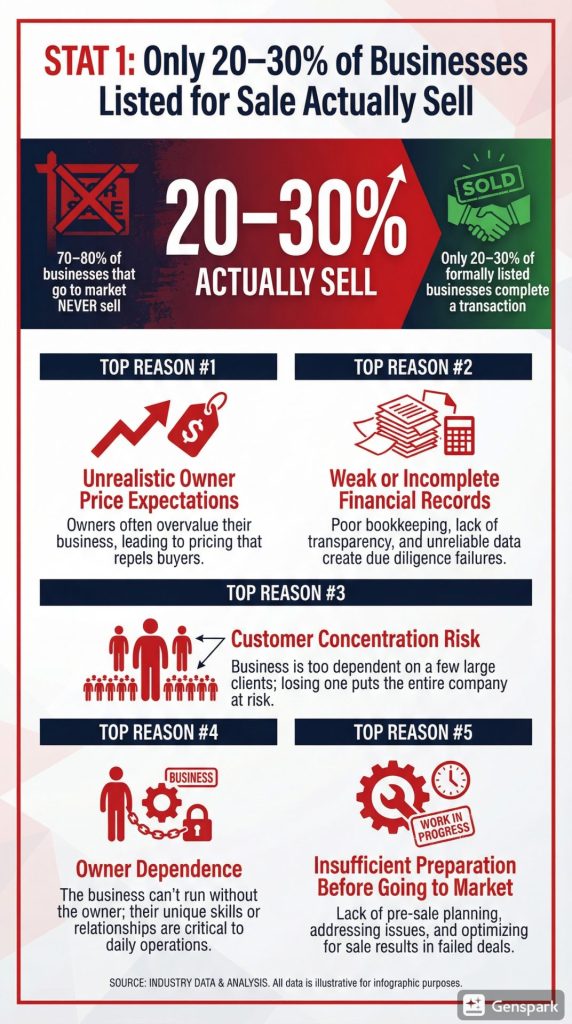
Stat1 - Only 20–30% of businesses for sale are sold. When a small business is formally put up for sale, only around 20–30% actually complete a transaction and close the deal. This means 70–80% of businesses that go to market never sell. The primary reasons include unrealistic owner price expectations, weak financial records, customer concentration risk, owner dependence, and insufficient preparation. Sources: IBBA Market Pulse Reports, BizBuySell data, business broker surveys
Stat 2 – Only 30-40% of businesses ever transfer ownership through sale. Investment banking analyses suggest only 30–40% of privately owned businesses ever successfully transfer to a new owner through a formal sale. The remainder shut down, are liquidated, or are informally handed to family members. Sources: Exit Planning Institute research, M&A advisor surveys
Stat 3 – More than 50% of businesses that hire a broker never receive an acceptable offer. Roughly half or more of businesses that formally engage a broker never receive an offer the owner is willing to accept. This valuation expectation gap is the most common reason listings are withdrawn. Sources: IBBA Market Pulse, business broker surveys
Stat 4 – Main Street businesses have lower close rates than lower-middle-market deals. Close rates are materially lower for very small "Main Street" businesses (under $2M value) than for lower-middle-market transactions ($2M-$50M), where processes are more professional and buyers more sophisticated. Sources: IBBA Market Pulse, Pepperdine Private Capital Markets Report
Stat 5 – Only 17% of active Main Street deals actually close. In certain Main Street segments, only about 17% of "active deals" that reach accepted offer or due diligence actually close. The majority fail due to financing, due diligence issues, or deal fatigue. Source: IBBA Market Pulse commentary
Stat 6 – 8% of deals take two years or longer to close. Approximately 8% of transactions drag on for two years or more, typically when owners are inflexible on terms, businesses hit operational problems mid-process, or there are buyer changes. Source: IBBA Market Pulse historical data
Stat 7 – 9,546 small businesses were sold in 2024. A total of 9,546 closed small-business transactions were reported through BizBuySell in 2024, representing 5% growth over 2023. Source: BizBuySell 2024 Insight Report
Stat 8 – 2,448 small businesses sold in Q2 2024 alone. Q2 2024 saw 2,448 closed transactions, returning to pre-pandemic volume levels. Source: BizBuySell Q2 2024 Insight Report
Stat 9 – Total enterprise value reached $7.59 billion in 2024. The aggregate value of 9,546 small businesses sold was $7.59 billion, a 15% increase over 2023 despite only 5% volume growth, indicating higher-quality businesses are selling. Source: BizBuySell 2024 Insight Report
Stat 10 – Approximately 500,000 businesses change hands annually in the USA. Combining all sources—marketplaces, private sales, M&A deals, franchise resales, and informal transfers—approximately 500,000 U.S. businesses change ownership each year. Source: BizBuySell research, business transfer estimates
Stat 11 – 1.1 million businesses opened and 983,000 closed in a recent period. SBA data shows approximately 1.1 million small businesses opened while about 983,000 closed, implying most owners exit by shutting down rather than selling. Source: SBA Small Business Profiles
Stat 12 – The U.S. business broker industry is valued at $1.8 billion. The U.S. business brokerage industry generates approximately $1.8 billion in annual revenue, growing due to Baby Boomer exits. Source: Marketdata LLC, U.S. Business Brokers Industry Report 2024
Stat 13 – There are 3,237 business brokerage firms operating in the USA. As of 2025, there are an estimated 3,237 business brokerage firms in the U.S., up 1.5% from 2024. Source: IBISWorld Business Brokers Statistics 2025
Stat 14 – 80% of the business brokerage market remains untapped. Only about 20% of businesses are sold through professional brokers, leaving 80% of the market untapped. Source: U.S. Business Brokers Industry Research Report
Stat 15 – The SBA supported 103,000 financings totaling $56 billion in FY 2024. In FY 2024, the SBA supported around 103,000 loans totaling $56 billion, much of which funds business acquisitions. Source: SBA 2025 Small Business Profiles
Stat 16 – Business broker industry revenue declined at 3.3% CAGR over 5 years. Industry revenue declined at 3.3% CAGR over five years, reaching $1.0 billion in 2025, reflecting economic volatility. Source: IBISWorld Business Brokers Industry Analysis 2025
Stat 17 – The number of business brokers remained flat (0.0% CAGR 2020-2025). The total number of brokerage firms remained essentially unchanged between 2020-2025, suggesting market maturity. Source: IBISWorld Business Brokers Statistics
Stat 18 – BizBuySell facilitates hundreds of thousands of successful sales. BizBuySell reports facilitating "hundreds of thousands of successful business sales" with 3+ million monthly site visits. Source: BizBuySell.com
Stat 19 – 65,000+ businesses are listed annually on BizBuySell. Approximately 65,000+ businesses are listed for sale annually on BizBuySell's platform. Source: BizBuySell marketplace statistics
Stat 20 – Average time to sell a business is 7-9 months. The average time from broker engagement to closing is 7-9 months across Main Street and lower-middle-market deals. Source: IBBA Market Pulse Q4 2024
Stat 21 – Larger deals ($5M-$50M) can take 9-13 months. Businesses valued $5M-$50M historically took up to 13 months to close, though recently this has fallen to 8-9 months. Source: IBBA Market Pulse, 37th & Moss analysis
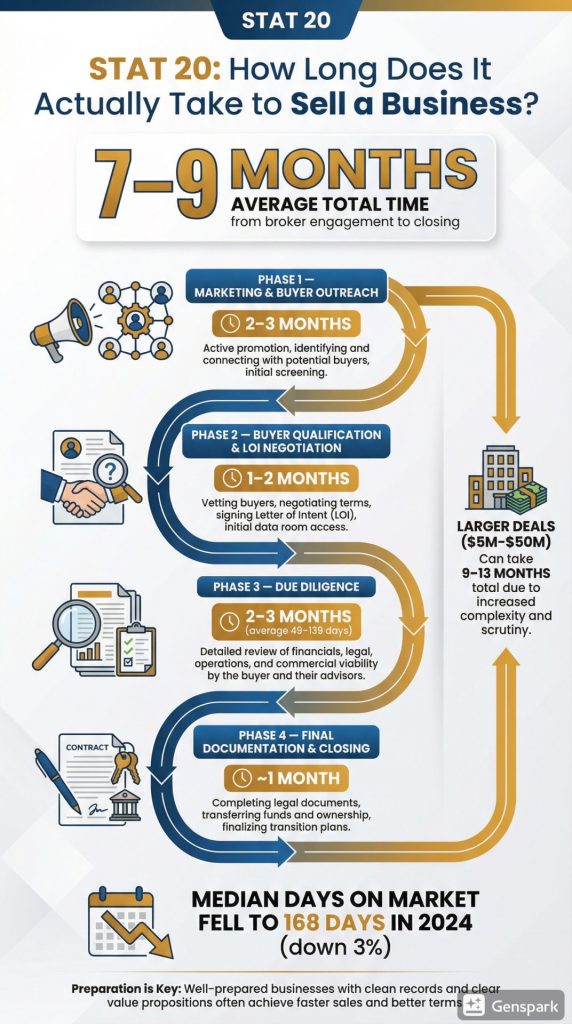
Stat 22 – Median days on market declined to 168 days in 2024. The median time on market fell to 168 days in 2024, down 3% from the prior year. Source: BizBuySell 2024 Insight Report
Stat 23 – Due diligence typically takes 30-90 days. Due diligence lasts 30-90 days for most deals, though smaller businesses may complete it in 2-4 weeks. Sources: M&A advisor surveys, DealRoom research, Lake Country Advisors
Stat 24 – Short due diligence averages 49 days; long periods average 139 days. "Short" due diligence averages 49 days, "medium" 139 days, with "long" processes exceeding 150 days. Source: Business-sale.com due diligence research
Stat 25 – Post-LOI timeline fell to 3 months in Q4 2024 for $5M-$50M deals. Time from LOI to closing fell to 3 months in Q4 2024, down from a historical average of 4 months. Source: 37th & Moss Q4 2024 Trends
Stat 26 – The typical sale process historically averaged 10 months for $5M-$50M. The complete sale process historically averaged 10 months (4 months post-LOI), now dropped to 8 months total. Source: 37th & Moss analysis
Stat 27 – SaaS M&A due diligence can close in as little as 2 weeks. In hot SaaS markets, due diligence has compressed to as little as 2 weeks, though 5 weeks is more typical. Source: Software Equity Group
Stat 28 – Median sale price hit $375,000 in mid-2024. The median sale price reached $375,000 in Q2 2024, up 25% year-over-year—an all-time high. Source: BizBuySell Q2 2024 Insight Report
Stat 29 – Median sale price was $345,000 for full-year 2024. For the full year 2024, the median sale price was $345,000, up 3% over 2023. Source: BizBuySell 2024 Full Year Insight Report
Stat 30 – Median sale price dropped to $325,000 in Q3 2024. Q3 2024 saw the median fall to $325,000, down 13% from the Q2 peak, though financials remained strong. Source: BizBuySell Q3 2024 Insight Report
Stat 31 – Sellers achieve approximately 95% of asking price at closing. Sellers average about 95% or more of their asking price or valuation benchmark at closing. Source: IBBA Market Pulse
Stat 32 – EBITDA multiples range from 3.6x to 8.8x by size and sector. Pepperdine research finds median EBITDA multiples range from 3.6x (smaller, riskier) to 8.8x (larger, higher-growth). Source: Pepperdine Private Capital Markets Report
Stat 33 – Lower-middle-market businesses ($5M-$50M) average 6.0x EBITDA. Businesses valued $5M-$50M averaged 6.0x EBITDA in late 2024, matching strong 2021 valuations. Source: IBBA Q4 2024 Market Pulse
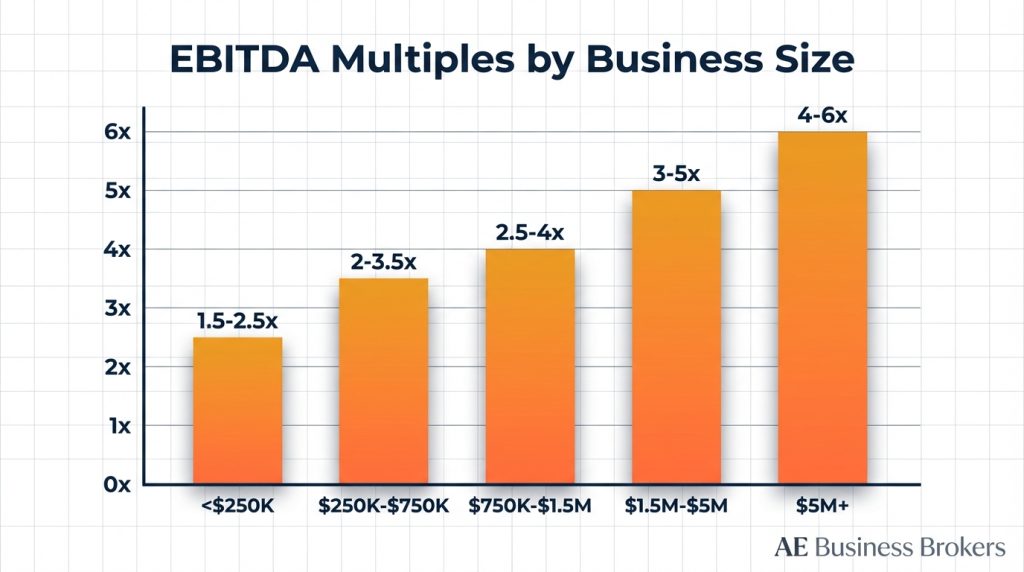
Stat 34 – Businesses under $250K EBITDA sell for 1.5-2.5x EBITDA. Very small businesses (<$250K EBITDA) typically sell for 1.5-2.5x EBITDA. Source: Raincatcher business valuation research
Stat 35 – Businesses with $250K-$750K EBITDA sell for 2.0-3.5x. Small businesses generating $250K-$750K EBITDA command 2.0-3.5x multiples. Source: Raincatcher research
Stat 36 – Businesses with $750K-$1.5M EBITDA sell for 3.0-5.5x. Companies with $750K-$1.5M EBITDA sell for 3.0-5.5x multiples. Source: Raincatcher research
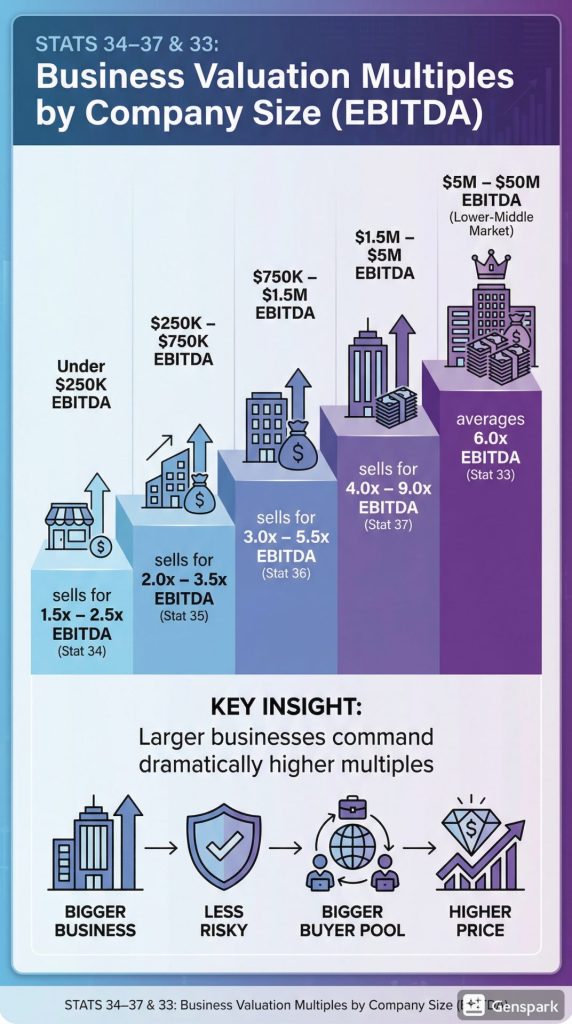
Stat 37 – Businesses with $1.5M-$5M EBITDA sell for 4.0-9.0x. Companies with $1.5M-$5M EBITDA command 4.0-9.0x multiples. Source: Raincatcher research
Stat 38 – Main Street deals (<$3M revenue) typically sell for 2.5-3.5x SDE. 90% of American businesses generate under $3M revenue and typically sell for 2.5-3.5x seller's discretionary earnings (SDE). Source: Raincatcher valuation research
Stat 39 – Lower-middle-market companies trade at 4-15x EBITDA. Companies with $2M-$100M revenue typically trade at 4-15x adjusted EBITDA depending on numerous factors. Source: Raincatcher research
Stat 40 – Small businesses typically sell for 2x-4x SDE. Small businesses (estimated value under approximately $10M) almost exclusively use SDE as the valuation metric and sell for 2x-4x SDE. Source: FE International valuation research 2025
Stat 41 – Cash flow multiples averaged 2.57 in 2024. The average cash flow multiple rose from 2.49 in 2023 to 2.57 in 2024, reflecting stronger valuations. Source: BizBuySell 2024 Insight Report
Stat 42 – Median cash flow was $158,950 in 2024. Median cash flow for sold businesses increased 3% to $158,950 in 2024. Source: BizBuySell 2024 Insight Report
Stat 43 – Median revenue was $703,000 in 2024. Median revenue for sold businesses increased 3% to $703,000 in 2024. Source: BizBuySell 2024 Insight Report
Stat 44 – Manufacturing businesses saw 35% increase in sales and 31% price jump. Manufacturing had a 35% increase in businesses sold and a 31% median price rise, outpacing other sectors. Source: BizBuySell 2024 data
Stat 45 – Manufacturing median sale price is $700,000. Manufacturing businesses have a median sale price of $700,000 with cash flow multiples up 9.5%. Source: BizBuySell 2024 Insight Report
Stat 46 – Online/technology businesses surged 74% in transaction volume. Online and technology businesses saw a 74% surge in transactions, with median sale price of $650,000 (down 24% from 2023). Source: BizBuySell 2024 Insight Report
Stat 47 – Building and construction grew 10% with $760,000 median price. Building and construction grew 10% in acquisitions with median sale price of $760,000 and stable valuations. Source: BizBuySell 2024 Report
Stat 48 – Service sector represents 40% of transactions. Service businesses account for 40% of all transactions with median sale price of $325,000. Source: BizBuySell 2024 data
Stat 49 – Service sector median price is $340,000 with 5% growth. Service sector median sale price rose 5% to $340,000 in 2025, with cash flow multiples up 2% to 2.52. Source: BizBuySell Insight Report 2025

Stat 50 – Financial services saw 38% gain in transactions. Financial services reported 38% gain in transactions with median sale price up 40% and cash flow up 15%. Source: BizBuySell 2025 data
Stat 51 – Technology services saw 12% gain with 15% price increase. Technology services saw 12% transaction growth, 15% median price increase, and 6% cash flow growth. Source: BizBuySell 2025
Stat 52 – Architectural/engineering firms up 17% in transactions. Architecture and engineering firms saw 17% transaction growth, 38% price increase, and 44% cash flow increase. Source: BizBuySell 2025
Stat 53 – Retail transactions remained flat with $255,000 median price. Retail saw flat transaction volume with median sale price of $255,000 and steady demand. Source: BizBuySell 2024
Stat 54 – Restaurant sales flat with $225,000 median, 4% revenue decline. Restaurant sales volume remained flat with median price $225,000, 4% revenue drop offset by higher margins. Source: BizBuySell 2024
Stat 55 – Restaurant median revenue reached $780,823 in Q2 2025. Restaurant median revenue was $780,823 in Q2 2025, up 6.9% year-over-year, showing sustained demand. Source: BizBuySell Q2 2025 Restaurant Analysis
Stat 56 – Restaurant cash flow declined 8% despite revenue growth. Restaurant median cash flow declined 8% due to tighter margins from rising food and labor costs. Source: BizBuySell Q2 2025
Stat 57 – Restaurant transactions down 16% year-over-year in Q2 2025. General business brokers reported 16% drop in restaurant sales year-over-year in Q2 2025. Source: BizBuySell Q2 2025
Stat 58 – E-commerce businesses typically sell for 1.85x SDE. According to Flippa historical data, e-commerce businesses sell for average of 1.85x SDE, with quality businesses reaching 2.0-4.0x. Source: Flippa transaction data
Stat 59 – E-commerce EBITDA multiples range 3.0x-10x. Larger e-commerce companies achieve EBITDA multiples of 3.0x to 10x based on growth and profitability. Source: Peak Business Valuation data
Stat 60 – E-commerce revenue multiples typically 0.3x-0.5x. Revenue multiples for high-growth e-commerce businesses range 0.3x-0.5x for market-capture strategies. Source: E-commerce valuation research
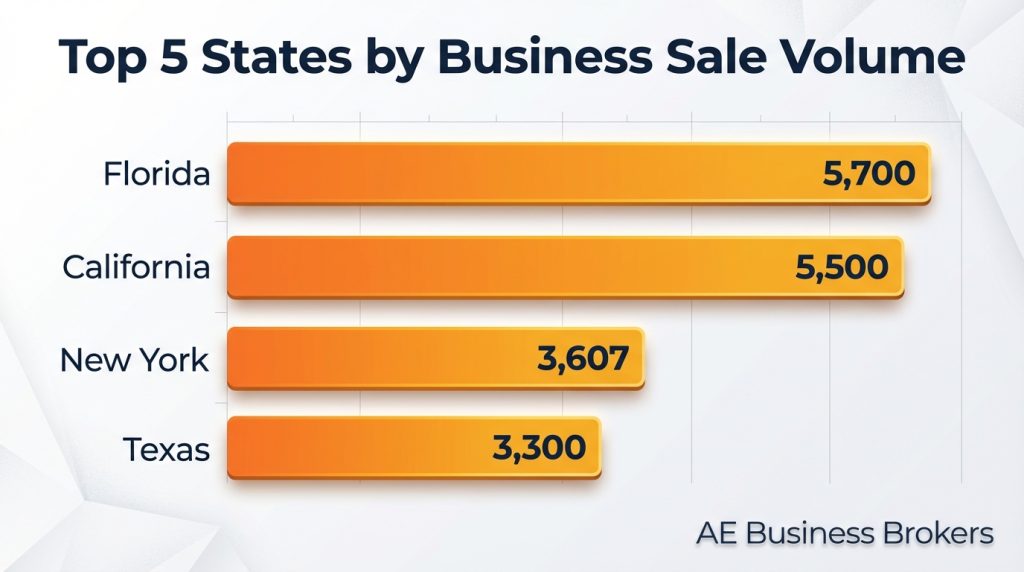
Stat 61 – California has approximately 5,500 businesses for sale. California currently has approximately 5,500 businesses listed for sale, the highest in the nation. Source: BizBuySell California market data
Stat 62 – California median asking price is $360,000. California's median asking price for businesses is $360,000. Source: BizBuySell California data

Stat 63 – California median revenue is $630,000. California businesses for sale report median revenue of $630,000. Source: BizBuySell California data
Stat 64 – California median earnings are $150,000. California median seller discretionary earnings are $150,000. Source: BizBuySell California data
Stat 65 – California earnings multiple is 2.5x. California businesses list at an average earnings multiple of 2.5x. Source: BizBuySell California data
Stat 66 – California revenue multiple is 0.6x. California businesses list at an average revenue multiple of 0.6x. Source: BizBuySell California data
Stat 67 – California profit margin averages 23%. California businesses for sale show an average profit margin of 23%. Source: BizBuySell California data
Stat 68 – Texas has approximately 3,300 businesses for sale. Texas currently has approximately 3,300 businesses listed for sale. Source: BizBuySell Texas market data
Stat 69 – Texas median asking price is $350,000. Texas median asking price is $350,000. Source: BizBuySell Texas data
Stat 70 – Texas median revenue is $650,000. Texas businesses report median revenue of $650,000. Source: BizBuySell Texas data
Stat 71 – Texas median earnings are $150,000. Texas median seller discretionary earnings are $150,000. Source: BizBuySell Texas data
Stat 72 – Texas earnings multiple is 2.3x. Texas businesses sell at an average earnings multiple of 2.3x. Source: BizBuySell Texas data
Stat 73 – Texas revenue multiple is 0.5x. Texas businesses sell at an average revenue multiple of 0.5x. Source: BizBuySell Texas data
Stat 74 – Florida has approximately 5,700 businesses for sale. Florida currently has approximately 5,700 businesses listed for sale. Source: BizBuySell Florida market data
Stat 75 – Florida median asking price is $350,000. Florida's median asking price is $350,000. Source: BizBuySell Florida data
Stat 76 – Florida median revenue is $610,000. Florida businesses report median revenue of $610,000. Source: BizBuySell Florida data
Stat 77 – 1,223 businesses sold in Florida in 2021. Florida saw 1,223 businesses sold in 2021, up 21% from 2020 (1,011 sales). Source: Green & Co Florida business sales analysis
Stat 78 – Florida average sold price was $630,374 in 2021. Florida's average sold price in 2021 was $630,374, up 57% from 2020 ($402,636). Source: Green & Co analysis
Stat 79 – Florida average SDE was $196,614 in 2021. Florida businesses had average SDE of $196,614 in 2021, up 31% from 2020. Source: Green & Co analysis
Stat 80 – New York City metro had 116 businesses sold in Q2 2024. NYC metro saw 116 businesses sold in Q2 2024 with median sale price of $467,500. Source: BizBuySell NYC Q2 2024 analysis
Stat 81 – NYC metro has 3,607 active listings. NYC metro had 3,607 active business listings in Q2 2024. Source: BizBuySell NYC data
Stat 82 – NYC median asking price is $390,000. NYC active listings have median asking price of $390,000. Source: BizBuySell NYC Q2 2024
Stat 83 – NYC median revenue is $700,000. NYC active listings report median revenue of $700,000. Source: BizBuySell NYC data
Stat 84 – NYC cash flow multiple averaged 2.75 in Q2 2024. NYC closed deals averaged 2.75x cash flow in Q2 2024, up from 2.35x in Q1. Source: BizBuySell NYC analysis
Stat 85 – California received 6,109 SBA 7(a) loan approvals totaling $3.63B. California leads in SBA lending with 6,109 approvals worth $3.63 billion, representing 13.2% of national SBA lending. Source: Bankrate SBA data 2023
Stat 86 – Texas received 5,530 SBA loans totaling $3.7B. Texas had 5,530 SBA loan approvals totaling $3.7 billion. Source: LendingTree SBA data FY2024
Stat 87 – Florida received 6,560 SBA loans totaling $3.6B. Florida received 6,560 SBA loan approvals totaling $3.6 billion. Source: LendingTree SBA data FY2024
Stat 88 – California average SBA loan per company was $584,094. California companies received average SBA loans of $584,094. Source: LendingTree FY2024 data
Stat 89 – Texas average SBA loan per company was $667,136. Texas companies received average SBA loans of $667,136. Source: LendingTree FY2024
Stat 90 – Florida average SBA loan per company was $541,630. Florida companies received average SBA loans of $541,630. Source: LendingTree FY2024
Stat 91 – Strategic buyers account for 55-57% of closed deals. Strategic buyers (existing companies in same/adjacent industry) represent 55-57% of closed transactions. Source: Pepperdine Private Capital Markets Report
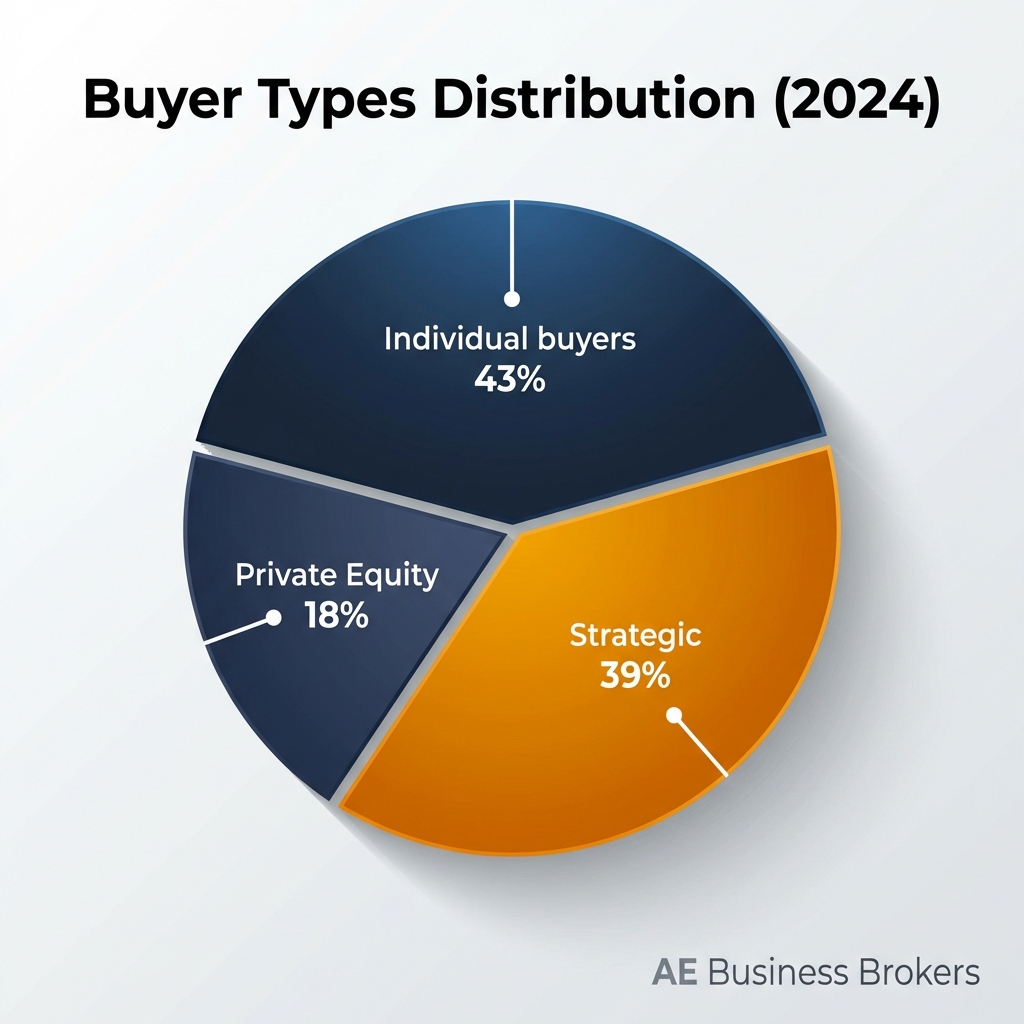
Stat 92 – Individual buyers represented 36% of $2M-$50M deals in 2023. Individual buyers accounted for 36% of deals valued $2M-$50M in 2023. Source: 37th & Moss analysis
Stat 93 – Strategic buyers represented 39% of deals in 2023. Strategic acquirers generated 39% of deal activity in 2023. Source: 37th & Moss analysis
Stat 94 – Private equity buyers represented 23% of deals in 2023. PE buyers represented 23% of $2M-$50M transactions in 2023. Source: 37th & Moss analysis
Stat 95 – Individual buyers represented 31-40% of deals from 2018-2022. Individual buyers consistently represented 31-40% of transactions over five years. Source: 37th & Moss historical analysis
Stat 96 – 70% of deals below $2M were completed by individual buyers in 2024. Individual buyers (first-time and serial) made up 70% of sub-$2M deals in 2024. Source: 37th & Moss Q4 2024 analysis
Stat 97 – 43% of $2M-$50M deals were individual buyers in 2024. Individual buyers accounted for 43% of $2M-$50M acquisitions in 2024, outpacing strategic and PE. Source: 37th & Moss Q4 2024
Stat 98 – 51% of advisors see no premium for strategic buyers. About 51% of respondents saw no pricing premium for strategic buyers over financial buyers. Source: Pepperdine analysis
Stat 99 – 33% observe 1-20% strategic buyer premiums. Roughly 33% observed premiums of 1-20% for strategic buyers in some deals. Source: Pepperdine analysis
Stat 100 – Buyers in 30s-40s increasingly using SBA loans to escape corporate life. Advisors report significant shift toward younger first-time buyers in 30s-40s using SBA loans, willing to pay premium multiples. Source: BizBuySell 2025 Insight Report advisor commentary
Stat 101 – 40% of U.S. small business owners are Baby Boomers. About 40% of small-business owners are Baby Boomers, creating the "silver tsunami" exit wave. Source: Project Equity research, Exit Planning Institute
Stat 102 – 2.3 million businesses owned by aging Boomers. Approximately 2.3 million small businesses are owned by aging Baby Boomers, employing about 24.7 million people. Source: Project Equity national study
Stat 103 – Business owners 55+ increased from 32% to 42% since 2000. The percentage of business owners aged 55+ rose from 32% to 42% since 2000. Source: University of Connecticut School of Business
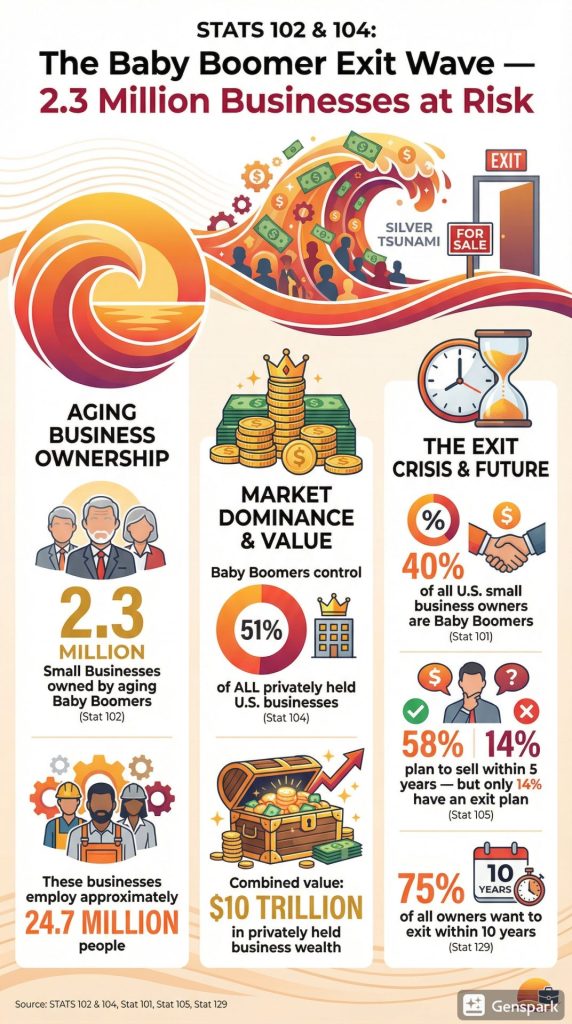
Stat 104 – Boomers own 51% of privately held businesses worth $10 trillion. Baby Boomers control 51% of privately held U.S. businesses, representing 3 million firms valued at $10 trillion. Source: Business succession planning reports
Stat 105 – 58% of Boomer entrepreneurs plan to sell within 5 years. 58% of Baby Boomer entrepreneurs expect to sell within five years, yet only 14% have an exit plan as a priority. Source: Exit planning surveys 2025
Stat 106 – Seller median age is 50-59 (35% of sellers). 35% of sellers are aged 50-59, making it the most common age bracket. Source: BizBuySell Demographics Survey 2016
Stat 107 – 19% of sellers are aged 60-69. 19% of business sellers are in the 60-69 age range. Source: BizBuySell Demographics Survey
Stat 108 – 25% of sellers are aged 40-49. 25% of sellers are in the 40-49 age bracket. Source: BizBuySell Demographics Survey
Stat 109 – Male sellers represent 78% of the market. 78% of business sellers are male, while 22% are female. Source: BizBuySell Demographics Survey
Stat 110 – 57% of sellers earn over $100,000 annual household income. Over half (57%) of business sellers have annual household incomes exceeding $100,000. Source: BizBuySell Demographics Survey
Stat 111 – Retirement is the #1 reason across all price ranges. Retirement is consistently the top motivation for selling in both Main Street and lower-middle-market deals. Source: IBBA Market Pulse Q4 2024
Stat 112 – 60% of sellers in $500K-$1M range cite retirement. In deals valued $500K-$1M, roughly 60% of sellers cite retirement as primary reason. Source: IBBA Market Pulse 2025
Stat 113 – No owners in $5M-$50M range spent more than 2 years planning exit. In the $5M-$50M range, advisors observed no owners spent more than two years planning their exit. Source: IBBA Q4 2024 Market Pulse
Stat 114 – 70-75% of owners regret selling within 12 months. About 70-75% experience significant regret within a year due to emotional and lifestyle factors. Source: Exit Planning Institute
Stat 115 – Only 2-5% are satisfied with net proceeds. Only 2-5% report being happy with after-tax proceeds after fees and deal structures. Source: Exit Planning Institute
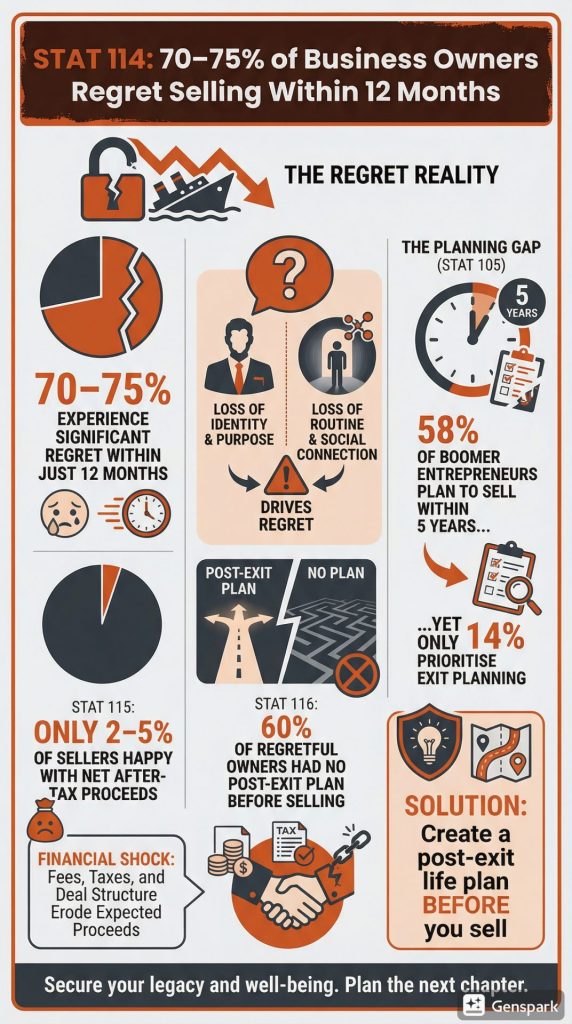
Stat 116 – 60% of regretful owners had no post-exit plan. Around 60% who regretted their sale had no formal personal plan for life after exit. Source: Exit planning research
Stat 117 – Main Street brokers charge 8-10% commission. Business brokers typically charge 8-10% for businesses under $1M, with 10% being most common. Source: Midstreet, BizBuySell
Stat 118 – Commission range is 10-15% for $100K-$1M businesses. Typical commission is 10-15% for businesses in this range. Source: BizBuySell broker fees guide
Stat 119 – Double Lehman formula common for $1M-$5M. Most brokers use: 10-12% on first $1M, 8% on second, 6% on third, 4% on fourth, 2% after. Source: Morgan & Westfield
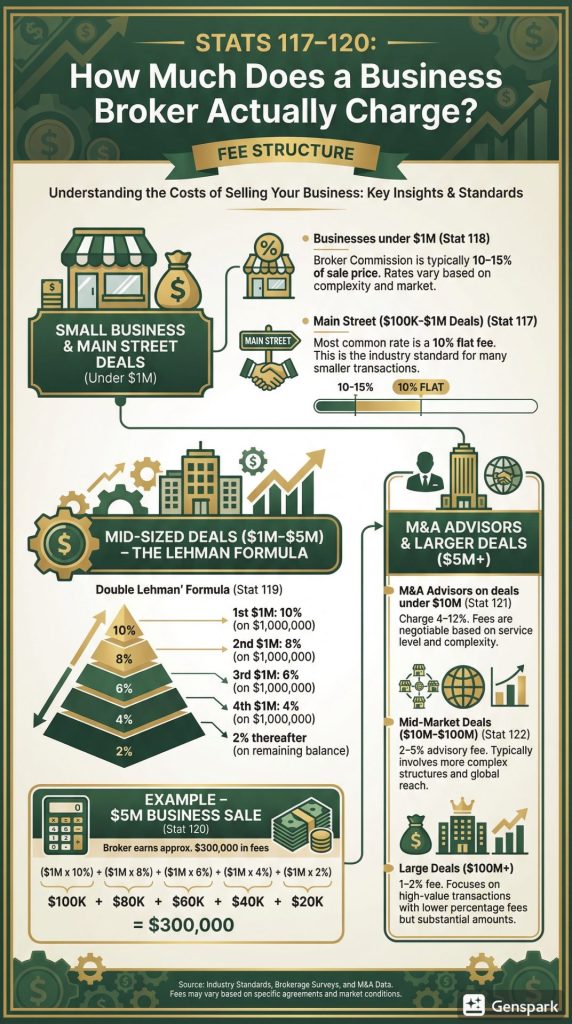
Stat 120 – A $5M business pays approximately $300K in broker fees. Using Double Lehman: $100K+$80K+$60K+$40K+$20K = $300K. Source: Morgan & Westfield
Stat 121 – M&A advisors charge 4-12% on small deals under $10M. M&A advisory fees average 4-12% on deals under $10M. Source: BizAdvisoryBoard
Stat 122 – Mid-market M&A fees are 2-5%. M&A fees drop to 2-5% for mid-market deals. Source: BizAdvisoryBoard
Stat 123 – Large M&A fees are 1-2%. Large transaction fees fall to 1-2%. Source: BizAdvisoryBoard
Stat 124 – Typical minimum M&A fee is $250K+. Most M&A firms have minimum fees of $250K or more. Source: BizAdvisoryBoard
Stat 125 – Buy-side M&A fees are typically 0.5-2% of transaction value. Buyers pay 0.5-2% depending on deal size and complexity. Source: DealRoom
Stat 126 – 82% of Main Street sellers willing to offer seller financing. About 82% of Main Street sellers open to competitive seller financing rates. Source: IBBA Market Pulse
Stat 127 – 70% of lower-middle-market sellers willing to offer seller financing. 70% of $2M-$50M sellers willing to provide seller financing. Source: IBBA Market Pulse
Stat 128 – Exit planning advisor population grew 70% in 2 years. Exit planner population reached 7,267, up 70% in two years. Source: Exit Planners Survey 2025
Stat 129 – 75% of owners want to exit within 10 years. 75% of business owners would like to exit within the next 10 years. Source: Exit Planning Institute 2023
Stat 130 – 32% of owners have no formal exit strategy. Despite exit desires, 32% have no formal exit strategy. Source: Exit Planning Institute 2023
Stat 131 – Buyer median age is 50-59 (36% of buyers). 36% of buyers are aged 50-59. Source: BizBuySell Demographics Survey
Stat 132 – 29% of buyers are aged 40-49. 29% fall in the 40-49 bracket. Source: BizBuySell Demographics Survey
Stat 133 – Male buyers represent 77% of the market. 77% of buyers are male, 23% female. Source: BizBuySell Demographics Survey
Stat 134 – 47% of buyers earn over $100K annually. Just over 47% of buyers have household incomes exceeding $100K. Source: BizBuySell Demographics Survey
Stat 135 – 25.5% of buyers earn under $50K. 25.5% earn less than $50K annually. Source: BizBuySell Demographics Survey
Stat 136 – "Be my own boss" motivates 68% of buyers. 68% of buyers cite independence as primary motivation. Source: BizBuySell Demographics Survey
Stat 137 – "Better income" motivates 51% of buyers. 51% seek higher income potential. Source: BizBuySell Demographics Survey

Stat 138 – Buyers are younger than sellers (23% under age 40). 23% of buyers are 39 or under vs 14% of sellers. Source: BizBuySell Demographics Survey
Stat 139 – 42% of buyers say performance is most important. 42% prioritize business performance when evaluating opportunities. Source: BizBuySell 2024
Stat 140 – 60% of buyers reported Fed rate cuts had no effect on timeline. Despite three Fed rate cuts in 2024, 60% said it didn't affect their purchase timeline. Source: BizBuySell 2024
SECTION 13: DEAL STRUCTURES & FINANCING
Stat 141 – Earn-outs dropped from 10% to 2% of deal value. Earn-outs in $5M-$50M deals fell from approximately 10% peak to approximately 2% of consideration. Source: IBBA Q4 2024
Stat 142 – SBA 7(a) loans go up to $5 million. SBA 7(a) offers loans up to $5M for acquisitions, partner buyouts, and expansion. Source: SBA.gov
Stat 143 – Average SBA 7(a) loan was $443,097 in FY2024. The average 7(a) loan size was $443,097. Source: LendingTree SBA study
Stat 144 – Average SBA 504 loan was $1.1 million. The average 504 loan was significantly larger at $1.1M. Source: LendingTree
Stat 145 – Working capital adjustments typically 2-3% of transaction value. Post-closing working capital adjustments commonly run 2-3% of deal value. Source: M&A transaction analysis
Stat 146 – Holdbacks and escrows often exceed 2-3% level. Holdback and escrow amounts frequently exceed the 2-3% threshold. Source: M&A value creation analysis
Stat 147 – Adjustment escrows don't follow the "1% rule". The common "1% rule" for adjustment escrows doesn't consistently apply across deals. Source: Goodwin Law M&A research
Stat 148 – 66.7% senior debt financing for $1M-$10M add-ons in 2024. Small add-on deals averaged 66.7% senior debt in Q1-Q3 2024. Source: GF Data
Stat 149 – Only 19.6% equity contribution for small add-ons. Equity contribution was just 19.6% for $1M-$10M add-ons. Source: GF Data
Stat 150 – 98% of Rocky Mountain BA transactions are asset sales. The vast majority (98%) of small-to-medium transactions are structured as asset sales. Source: Rocky Mountain Business Advisors
Stat 151 – Approximately 30% of all transactions are stock sales. DealStats reports roughly 30% of transactions use stock sale structure. Source: DealStats database
Stat 152 – Stock sales more common as business size increases. Smaller deals favor asset sales; larger deals increasingly use stock structures. Source: Transaction structure research
Stat 153 – Global franchise resale market expected to reach $17.83B by 2035. The market is projected to grow from $11.39B (2025) to $17.83B (2035) at 4.7% CAGR. Source: Business Research Insights
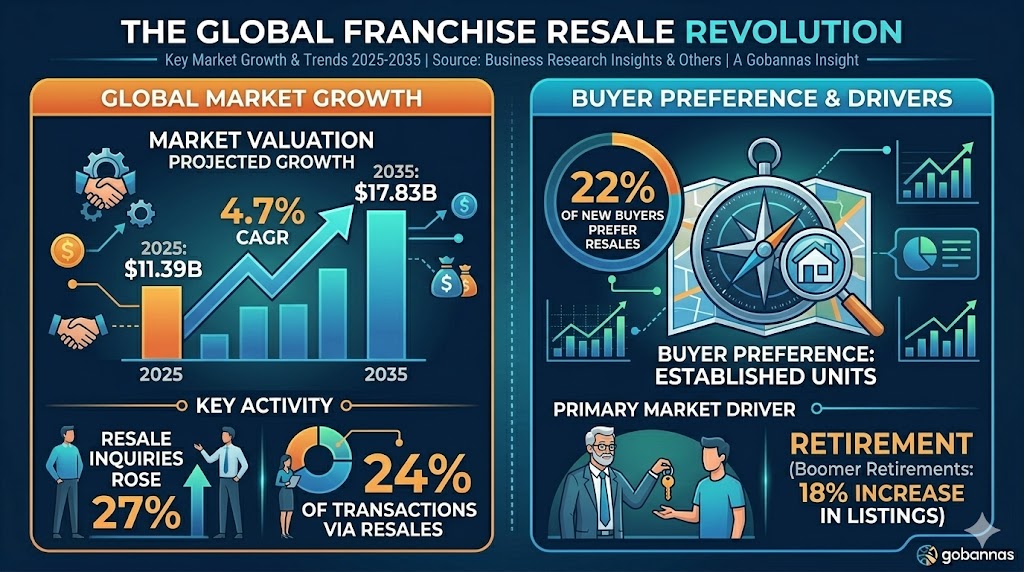
Stat 154 – Franchise resale inquiries rose 27%. Inquiries increased 27% globally with 24% of franchise transitions via resales. Source: Franchise Resale Market research
Stat 155 – 811,000 franchise establishments in the U.S. in 2024. The U.S. had an estimated 811,000 franchise locations. Source: Statista
Stat 156 – Franchise resale listings rose 18% in 2023 due to Boomer retirements. SBA data shows 18% increase driven by retiring Baby Boomers. Source: Franchise Resale Market research
Stat 157 – 22% of new franchise buyers prefer resales over new units. IFA noted 22% prefer acquiring established outlets. Source: IFA research
Stat 158 – 24% of total franchise transactions in 2023 were resales. Nearly one-quarter of all franchise deals were resales. Source: U.K. Department for Business and Trade
Stat 159 – We Sell Restaurants grew 15.5% while general market fell 16%. The specialist broker outperformed the general market by 31.5 percentage points in restaurant resales. Source: We Sell Restaurants Q2 2025
Stat 160 – Franchise resales up 62.7% at We Sell Restaurants. Franchise resales nearly doubled year-over-year. Source: We Sell Restaurants 2025
Stat 161 – Business owners spend $35.5B annually during ownership transitions. Buyers and sellers combined spend over $35B on suppliers/vendors during transitions. Source: BizBuySell ownership transition survey
Stat 162 – 83% of buyers increased spending during transition. 83% of buyers either increased spending, added products, or switched vendors. Source: BizBuySell survey
Stat 163 – 33% of sellers increased spending during transition. 33% of sellers invested in their business pre-sale to support higher valuations. Source: BizBuySell survey
Stat 164 – 53% of new owners added or switched providers. 53% added new providers or switched entirely post-acquisition. Source: BizBuySell survey
Stat 165 – 59% of advisors reported more signed NDAs in 2024 vs 2023. Buyer engagement increased at the NDA stage. Source: IBBA Q4 2024
Stat 166 – 48% of advisors saw more LOIs submitted in 2024. Letter of intent activity rose year-over-year. Source: IBBA Q4 2024
Stat 167 – 43% of advisors described lending as "more restrictive" in 2024. Despite growth in deal volume, lending tightened. Source: IBBA Q4 2024
Stat 168 – 34% of owners say performance improved since last year. More than one-third report better business performance. Source: BizBuySell 2024
Stat 169 – 58% credit customer increases for improvement. 58% attribute performance gains to increased customers. Source: BizBuySell 2024
Stat 170 – PE has approached 20% of owners about selling. One-fifth report private equity inquiries. Source: BizBuySell 2025
Stat 171 – 46% report multiple PE inquiries per year. Nearly half receive repeated PE approaches annually. Source: BizBuySell 2025
When you decide to sell your business, finding the right business sale broker is one of the most important decisions you will make. The right broker can help you navigate the complexities of selling your business, from valuation to finalizing the deal. In this guide, we’ll walk you through the key factors to consider when choosing a business sale broker, and why partnering with an experienced firm like AE Brokers (visit their website.

A business sale broker, also known as a business intermediary or mergers and acquisitions (M&A) advisor, is a professional who facilitates the sale of a business. They help business owners find potential buyers, negotiate the sale terms, and ensure the transaction is completed smoothly and legally. Their role is crucial to securing a fair price for your business and to managing the complexities of the sale process.
Choosing a broker with industry-specific experience is essential. Each industry has its unique challenges, trends, and buyer profiles. A broker with experience in your sector will be better equipped to assess your business’s value, find suitable buyers, and understand the nuances of your business model.
Why AE Brokers?
AE Brokers specialize in various industries and have a deep understanding of what works in different sectors. Their knowledge and expertise ensure they can navigate the complexities of your industry, whether you own a manufacturing business, retail store, or tech startup.

A business sale broker's reputation is critical to ensuring a smooth sale process. Look for a broker with a proven track record of successfully closing business sales. You can request references, read online reviews, and review testimonials from past clients.
Why AE Brokers?
AE Brokers have earned a reputation for delivering results. Their extensive portfolio of completed transactions demonstrates their expertise in helping business owners like you sell their businesses quickly and at the best possible price. Review their testimonials to see why clients trust them with such a critical transition.
Business brokers typically charge a commission, typically 5% to 10% of the final sale price. However, some brokers may also charge upfront fees or additional costs for marketing and other services. It’s crucial to understand the broker’s fee structure and ensure there are no hidden charges.
Why AE Brokers?
AE Brokers offer a transparent pricing structure with no hidden fees. Their commission is straightforward, and they work hard to secure the best possible deal while keeping the process as cost-effective as possible.
A good business sales broker should have a broad network of potential buyers, including individual investors, companies seeking acquisitions, and private equity firms. They should also have effective marketing strategies in place to attract qualified buyers for your business.
Why AE Brokers?
AE Brokers have an extensive network of buyers and investors, both locally and globally. Their marketing strategy is tailored to your business type, ensuring that it reaches the right buyers. Whether they’re using online platforms, industry-specific channels, or leveraging their own contacts, AE Brokers have the tools to market your business to the right audience.
Confidentiality is a top priority when selling a business. You don’t want your employees, customers, or competitors to know that you are looking to sell until the deal is finalized. A professional business sale broker will ensure that your business’s sale remains confidential throughout the process.
Why AE Brokers?
AE Brokers understand the importance of discretion. They take confidentiality seriously and use non-disclosure agreements (NDAs) to protect your business interests. Their process ensures that sensitive information remains private, reducing the risk of disruption to your operations during the sale.
Negotiating the sale of a business can be a delicate and challenging process. A skilled business broker will help you get the best deal by navigating tough negotiations, addressing buyer concerns, and handling any objections that may arise.
Why AE Brokers?
AE Brokers are expert negotiators with years of experience in securing favorable terms for business owners. Their negotiation skills are one of the reasons many businesses are sold faster and at a higher price than they might have achieved otherwise.
Selling a business involves more than just finding a buyer. You’ll need assistance with due diligence, legal documentation, financial disclosures, and closing the deal. Choose a broker who offers comprehensive support throughout the entire process.
Why AE Brokers?
From valuation to closing, AE Brokers offer end-to-end support. Their team of experts, including accountants and lawyers, work together to ensure the sale process is smooth and all legal and financial aspects are handled correctly.
AE Brokers specialize in fast-tracking business sales. Their streamlined process is designed to reduce the time it takes to find a buyer, negotiate terms, and close the deal. This means less stress for you and a quicker transition.

AE Brokers work diligently to maximize the value of your business. Their experience and strategic marketing techniques allow them to present your business in the best possible light to potential buyers.
With access to a broad range of potential buyers, AE Brokers help ensure that your business sale reaches the right audience. Whether it’s a local buyer or an international investor, AE Brokers can find the right match for your business.
If you’re ready to sell your business and want to ensure a smooth, successful transaction, AE Brokers can help. Visit their website at sellmybusinessfast.org to schedule a free consultation and learn how their expert team can assist you in selling your business quickly and at the best price.
Choosing the right business sale broker is a critical step in ensuring the success of your business sale. By focusing on experience, reputation, transparency, and a comprehensive support system, you can find a broker who will streamline and improve profitability. AE Brokers offers a wealth of knowledge and resources to guide you through every stage of selling your business, ensuring that you achieve the best possible outcome. Reach out to them today and take the first step toward selling your business with confidence.
If you’re considering selling a business valued at $1M or more in Chicago, the process is both an opportunity and a challenge. The stakes are high: you want the best possible price, a seamless transaction, and a trustworthy expert who understands the local market. This article explains, step-by-step, what business owners like you actually need to know—so you can make an informed decision and maximize the value of your hard-earned asset.
If you own a substantial business in Chicago, choosing to partner with an experienced business broker can directly impact your financial outcome. Here’s what separates a standout broker from the crowd:
Tip: A great broker acts as both shield and advocate—screening buyers, guiding you through due diligence, and resolving issues before they can derail the deal.
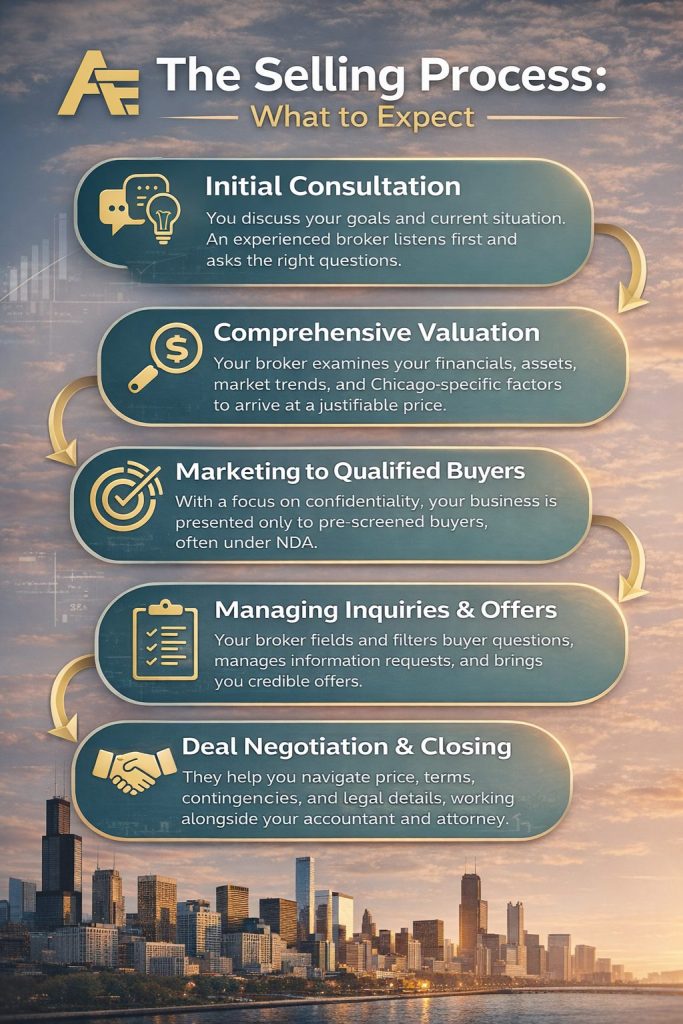
Selling a larger business is not a simple classified posting. It is a carefully managed, multi-step sequence:
Chicago isn’t just another large city. The area’s economic landscape, regulatory environment, and buyer pool are distinct. Here’s why going local is a must:

Look for a broker who demonstrates:
Tip: Don’t be swayed by generic promises. Insist on case studies and testimonials relevant to your business size and industry.
Q: How long does it take to sell a $1M+ business in Chicago?
A: Most sales take 6–12 months, but a skilled broker can accelerate the process by targeting ready buyers and preparing due diligence upfront.
Q: How do I keep the sale confidential?
A: A professional broker uses NDAs and limits exposure, ensuring your employees, vendors, and competitors do not learn of the sale before you’re ready.
Q: What does a broker charge?
A: Expect fees from 8–12% of the closing price, typically contingency-based (you pay only upon closing). Some may offer fixed-fee consultation for valuations.
If your business is thriving and you are considering an exit, find out what it’s truly worth in today’s Chicago market. Knowledge is leverage—whether you choose to move forward now or later.
Get a Free Business Valuation
(Use the contact form in the right-hand sidebar for a confidential, no-obligation analysis.)
Choosing the right business broker in Chicago is not just about the sale; it’s about protecting the legacy of what you’ve built. Set yourself up for success with local, trusted expertise.
What’s your biggest concern about selling right now? Are you ready for your business’s true value?
Let’s start the conversation—your next chapter begins here.
Looking to buy or sell a business in Naples, FL? A.E. Business Brokers, the best Business Brokers in Naples, FL, is here to assist you every step of the way. With our expertise and experience in the local market, we have established ourselves as the go-to resource for all your business brokerage needs in Naples.
Our team of dedicated professionals understands not only the unique challenges and opportunities that come with buying or selling a business but also the intricate dynamics of the vibrant coastal city of Naples, FL.
Whether you are a seasoned entrepreneur looking to expand your portfolio or a first-time buyer looking for the perfect investment opportunity, we have the knowledge and resources to guide you through the process.
From valuation and marketing to negotiations and closing, we will work tirelessly to ensure a seamless and successful transaction. Trust A.E. Business Brokers Naples to help you achieve your business goals in this thriving market.
At A.E Business Brokers Naples, FL, we don't just claim to be the best. We have a proven track record of successfully facilitating business sales in the Naples area. Our team has a deep understanding of the local market dynamics and knows how to navigate the complexities of buying and selling businesses in this region.
Client Testimonials and Case Studies: Don't just take our word for it—hear from our satisfied clients! We have a collection of testimonials that showcase the positive experiences our clients have had working with us. We also provide case studies that highlight specific business sales we have completed, demonstrating our expertise and ability to deliver results.
Industry Awards and Recognitions: Industry leaders have recognized our commitment to excellence. We are proud recipients of various awards and accolades acknowledging our outstanding performance as Business Brokers. These accolades serve as a testament to our professionalism, integrity, and success in helping businesses achieve their goals.
Our team at A.E Business Brokers Naples, FL, is comprised of highly experienced professionals with a wealth of knowledge in business brokerage. Each member brings unique qualifications and expertise to the table, ensuring that our clients receive top-notch service throughout the entire process.
Relevant Qualifications: Our team members hold relevant qualifications, such as certifications in business brokerage and real estate. These credentials demonstrate their expertise and dedication to providing exceptional service to our clients.
Years of Experience: With years of experience in the field, our team understands the intricacies of buying and selling businesses. We have encountered various scenarios and challenges, allowing us to anticipate potential issues and find effective solutions. Our experience translates into a smoother and more successful transaction for our clients.
Ongoing Training and Professional Development: We believe in continuous improvement and staying up-to-date with the latest trends and best practices in business brokerage.
Our team regularly participates in training programs and professional development opportunities to enhance their skills and knowledge. This commitment ensures that we are always equipped with the most current strategies and tools to serve our clients effectively.
At Business Brokers Naples, FL, we understand that each business is unique and requires a tailored approach to achieve a successful sale. We work closely with our clients to develop personalized selling strategies that align with their specific goals and objectives.
Personalized Plans: We thoroughly analyze each business and its market position. Based on this analysis, we create customized plans that outline the steps needed to attract qualified buyers and maximize the business's value.
Market Trends and Buyer Preferences: Our team stays informed about the latest market trends and buyer preferences. By understanding what buyers are looking for in businesses, we can position our clients' businesses to appeal to potential buyers, increasing the likelihood of a successful sale.
Unique Selling Propositions: To stand out in a competitive market, we help our clients identify their unique selling propositions. These are the qualities or features that set their businesses apart from others. By highlighting these unique aspects, we can attract buyers who recognize the value and potential of the business.

At A.E Business Brokers Naples, FL, we have developed a ten-step methodology to ensure a smooth and successful selling process for our clients. This structured approach guarantees thoroughness and maximizes the chances of a favorable outcome.
One key advantage of working with A.E. Business Brokers Naples, FL, is our ability to match sellers with pre-qualified buyers quickly. We leverage advanced technology and our extensive network to identify potential buyers who are actively seeking business acquisitions.
By streamlining communication between buyers and sellers, we expedite the sales process and increase the likelihood of a successful transaction. Our efficient buyer-matching system saves time for both parties involved and ensures that the right buyers are connected with the right businesses.
At A.E Business Brokers Naples, FL, we maintain an extensive database of potential buyers. This database is regularly updated with new leads and is segmented by industry and investment criteria. By categorizing buyers based on their specific preferences, we can target the most relevant audience for each business listing.
Our comprehensive buyer database allows us to efficiently market businesses to a wide range of potential buyers. This process increases the chances of finding the ideal buyer who aligns with the seller's objectives. With our extensive network and thorough knowledge of the local market, we have access to a diverse pool of qualified buyers.
Accurate valuations play a crucial role in the success of selling a business. When it comes to determining a business's value, potential buyers rely heavily on the information provided by the valuation process. A business valuation provides an objective assessment of the company's worth, which helps buyers make informed decisions.
Market conditions also significantly impact a business's value. During periods of economic growth, businesses tend to have higher valuations due to increased demand and competition.
Conversely, during economic downturns, businesses may experience a decrease in value. Understanding these market conditions is essential for both buyers and sellers to navigate the business sale process effectively.
Moreover, valuation plays a vital role in setting realistic expectations for sellers. It provides them with a clear understanding of their business's worth, enabling them to make informed decisions about pricing and negotiation strategies.
With an accurate valuation in hand, sellers can confidently approach potential buyers and engage in productive discussions.
Obtaining a valuation for your business is straightforward and involves several steps. First, you need to gather all the necessary financial and operational information about your business.
This process includes financial statements, tax returns, and other relevant documents. Once you have collected this information, you can submit it to a business broker who specializes in valuations.
The valuation process typically takes two to four weeks, depending on the complexity of the business and the availability of data. During this time, the appraiser analyzes various factors, such as industry trends, financial performance, and market conditions, to determine the value of your business.
Transparency is key throughout the valuation stages. The appraiser should provide regular updates on the valuation's progress and be available to answer any questions or concerns you may have. By maintaining open communication and transparency, you can ensure a smooth and reliable valuation process.
Requesting a valuation is simple. Potential sellers can use multiple methods to contact A.E. business brokers. You can also contact them directly via phone or email to discuss your needs and request a valuation.
Alternatively, many brokers also offer online request forms on their websites, making it easy for sellers to initiate the valuation process.
To request a valuation, provide your contact information and some basic details about your business, such as its industry, location, and annual revenue. The broker will then get in touch with you to gather additional information and guide you through the valuation process.

At our business brokerage firm, we understand the importance of client satisfaction. That's why we offer a no-sale, no-fee promise to our clients. This means that you only pay us if we successfully sell your business.
We believe in the value of our services and are committed to delivering results. Our promise sets us apart from competitors who may charge fees regardless of whether or not they are able to sell your business.
Confidentiality is crucial when selling your business. We prioritize the protection of your sensitive business information throughout the entire selling process. Our team implements rigorous measures to ensure that all transactions are conducted with the utmost confidentiality.
We have strict policies to safeguard your data and communicate these policies to all parties involved. When working with us, you can trust that your information is in safe hands.
We take pride in our track record of helping clients achieve their goals through successful business sales. Our portfolio includes a wide range of client success stories across various industries. These stories highlight the role our brokerage plays in facilitating profitable business opportunities.
Whether it's a small office or a large corporation, we have helped businesses of all sizes find the right buyers and close successful deals. When you choose our services, you can expect personalized attention, expert guidance, and a proven track record of client success.
We highlighted our unique selling process, which sets us apart from other brokers in the area. We also emphasized the importance of a free business valuation and how it can help you make informed decisions.
Throughout the article, we have showcased our expertise and demonstrated why we are the right choice for your business needs.
[Conclusion] In conclusion, if you are looking to buy or sell a business in Naples, FL, our team of experienced business brokers is here to assist you every step of the way. With our unique selling process and commitment to providing a free business valuation, we are dedicated to ensuring your success. Don't hesitate to reach out to us today and let us help you achieve your business goals.
Business brokers in Naples, FL, can assist you in buying or selling a business by providing expert guidance, conducting market research, facilitating negotiations, and ensuring a smooth transaction process.
Their local knowledge and network can significantly increase your chances of finding the right buyer or seller.
Our selling process stands out due to its personalized approach. We tailor our strategies to meet the specific needs of each client, utilizing comprehensive marketing techniques, thorough business valuation, and targeted buyer outreach. This process ensures maximum exposure for your business and increases the likelihood of a successful sale.
Absolutely! We provide complimentary business valuations to help you understand your business's worth in today's market. Our experienced team will analyze various factors, such as financial performance, industry trends, and comparable sales data, to provide an accurate assessment of your business's value.
By choosing our services, you gain access to a team of experienced professionals who specialize in business brokerage. We have an extensive network of potential buyers and sellers, enabling us to connect you with the right opportunities.
Our expertise ensures a streamlined process, saving you time and effort and maximizing the value of your transaction.
You can reach out to our Naples business brokers by calling our office at [phone number] or sending us an email. We are available to answer any questions you may have and provide further information on how we can assist you in achieving your business goals.
Did you know that some business brokers charge an 'average business broker commission' of 10% upfront on the sale price of a business? That's right, a significant chunk of your hard-earned profits goes straight into their pockets.
But what if there was a better way to sell your business without paying exorbitant or upfront fees? Whether you're a small business owner looking to sell or an entrepreneur searching for a profitable venture, this information will revolutionize the way you approach buying or selling a business.

When considering a business broker, it's important to note that practices around valuation fees vary. Some brokers may charge a fee for providing a professional valuation, especially if the valuation is needed for reasons other than selling, such as settling an ownership dispute.
However, many brokers offer flexibility. They may waive the valuation fee if you decide to proceed with them as your business broker, potentially saving you money. Furthermore, some brokers provide free valuations, making it easier to explore your options without upfront costs.
By understanding these different approaches, you can make a more informed decision that aligns with your business needs and goals.
Business brokers play a crucial role in facilitating business sales. They act as intermediaries between buyers and sellers, helping to connect the right parties and navigate complex transactions.
These professionals are well-versed in the intricacies of the buying and selling process, providing valuable expertise to both sides.
One of the primary functions of business brokers is to help sellers find qualified buyers for their businesses. They have access to a wide network of potential buyers and can effectively market the business to attract interested parties.
By leveraging their industry knowledge and connections, brokers can identify suitable buyers who are genuinely interested in acquiring a business.
Working with a business broker offers strategic advantages for buyers. Brokers have an in-depth understanding of the market and can provide valuable insights into different industries and opportunities.
They can help buyers identify businesses that align with their goals and objectives, saving them time and effort in the search process.
Business brokers typically operate on a commission-based structure. This process means that they earn a percentage of the final sale price when a transaction successfully closes.
The average business broker commission rate can vary depending on factors such as the size of the business and the complexity of the deal.
Some brokers offer additional services, such as consulting or advisory services, in addition to commissions. These services may include business valuations, financial analysis, and guidance throughout the buying or selling process.
By diversifying their revenue streams, brokers can provide comprehensive support to their clients while also generating additional income.
Performance-based earnings are also important for brokers. Their reputation and success depend on their ability to close deals efficiently and effectively.
By delivering results and satisfying their clients, brokers can build a strong track record and attract more business in the future.
The fees charged by business brokers can vary depending on several factors. Small business broker fees typically range from 8% to 12% of the final sale price. However, for larger businesses or middle market transactions, the fees may be negotiable and can range from 5% to 10%.
In addition to these overall small business broker fees, it's important to consider upfront costs. Business brokers who require an initial payment usually charge between $500 and more than $40,000. This amount can depend heavily on the anticipated sale price and the specific services included.
The good news for sellers is that many brokers operate on a success-fee basis, which means they only get paid if the sale goes through. This minimizes initial financial risk and aligns their incentives with the seller's goals.
These fees generally cover a range of services provided by the broker, including:
Sellers need to understand what services are included in the fee structure and clarify any additional costs that may arise throughout the process. With this knowledge, they can make informed decisions about which business broker to choose.
When it comes to business sales, the burden of the brokerage fee usually falls on the seller. Business brokers tend to represent the business owner during the transaction. Consequently, it’s the seller who generally handles these costs.
By understanding these structures, sellers can make informed decisions about how they engage with business brokers and plan their expenses accordingly.
When engaging with business brokers, it’s common for them to establish formal contracts. These agreements provide brokers with the necessary time to identify the right buyer and manage the complexities of the sale process.
Typically, these contracts last from six months to one year. This timeframe allows brokers to market the business effectively, vet potential buyers, and negotiate favorable terms without the pressure of an immediate deadline.
Thus, a six to twelve-month contract is standard to ensure a well-managed transaction, offering both parties the best chance of a successful closing.

When it comes to selling a business, maintaining confidentiality is crucial. Business brokers play a vital role in safeguarding the privacy of the transaction. Here’s how they do it:
By using these strategies, business brokers ensure that the sale process is conducted with the utmost discretion, finding a buyer who aligns with the seller's criteria while preserving the privacy of the business.

Success fees are a common type of business broker fee. These fees are contingent on the broker successfully closing a sale for their client. In other words, the broker only receives payment if they achieve a positive outcome for the client.
This arrangement ensures that the broker has a strong incentive to work diligently and effectively to sell the business.
Typically, success fees are calculated as a percentage of the total sale price. The exact percentage can vary depending on factors such as the size and complexity of the business, industry norms, and the specific agreement between the broker and the client.
However, success fees of 5% to 15% of the sale price are not uncommon. One key advantage of success fees is that they align the broker's incentives with the client's goals. Since brokers earn their fees based on successfully closing a sale, they have a vested interest in achieving the best possible outcome for their clients.
This process motivates them to invest time and effort into finding qualified buyers, negotiating favorable terms, and ensuring a smooth transaction process.
In addition to success fees, some business brokers may also charge retainers or upfront fees. Retainers are typically paid at the beginning of the engagement and serve as an initial payment to secure the broker's services.
They demonstrate the client's commitment to working with the broker and compensate them for their initial efforts in evaluating and preparing the business for sale.
Upfront fees, on the other hand, are payments made by clients before the broker does any work. These fees can vary in amount and purpose, such as covering administrative costs or conducting market research.
Clients need to understand how upfront fees will be used and whether they are refundable under certain conditions.
However, it's worth noting that not all brokers charge retainers or upfront fees. Some may solely rely on success fees as their compensation structure.
The decision to charge these additional fees ultimately depends on the broker's business model and the specific circumstances of the engagement.
Below is a table showing the top business brokers in the US with their upfront and retainer fees
| Business Broker | Upfront Fees | Retainer Fees |
| A.E. Business Brokers | No Fees | No Fees |
| Sunbelt Business Brokers | $10,000 | $5,000 |
| Transworld Business Advisors | $15,000 | $3,000 |
| Murphy Business & Financial Corporation | $12,000 | $4,000 |
One alternative fee structure that some brokers offer is deferring payment until after the sale is completed. This arrangement can benefit both the broker and the client.
By deferring payment, brokers demonstrate their confidence in their ability to sell the business successfully. They only receive compensation if the transaction is finalized.
This payment model reduces clients' financial risk. They don't have to pay any upfront fees or retainers, allowing them to allocate their resources more effectively during the selling process.
Since brokers are financially invested in achieving a successful sale, they are more likely to go above and beyond to secure a favorable outcome for their clients.

Additional factors must be considered when selling a business that involves real estate. In many states, business brokers need to hold a real estate license to include any property in the transaction legally. This requirement ensures compliance with real estate laws and prevents legal complications during the sale process.
However, not all states follow the same rules. For example, Texas does not mandate a real estate license for business brokers. In such cases, brokers might need to collaborate with a licensed real estate agent to navigate the sale smoothly, especially if they aren't licensed themselves.
The situation is slightly different when the real estate is leased rather than owned. In these scenarios, the property can sometimes be regarded as “incidental” to the business. Leased properties may not require the same level of legal oversight since they aren't owned by the business being sold.
Key Takeaways:
Understanding these distinctions can significantly influence the smooth execution of a business sale involving real estate. Always verify local regulations to ensure compliance and a hassle-free transaction.

When it comes to business broker charges, clients have the opportunity to negotiate the fee structure with their brokers. It is important for clients to openly discuss their expectations and concerns regarding fees before entering into a contract.
Negotiation is a common practice in the brokerage industry, as brokers understand that each client's situation is unique and may require different levels of service.
For example, if a client has already done extensive groundwork in preparing their business for sale, they may be able to negotiate a lower fee based on the reduced workload for the broker.
Clients should also consider the value they receive in return for the fees paid to the broker. Brokers provide a range of services, including business valuation, marketing, finding potential buyers, and negotiating deals. By understanding the value provided by the broker, clients can make informed decisions about fee negotiations.
Several factors can influence the fees charged by business brokers. One significant factor is the size and complexity of the business being sold. Larger businesses often require more time and resources from brokers, resulting in higher fees.
Market conditions can impact fee structures. In a competitive market with high demand for businesses, brokers may charge higher fees due to increased demand for their services.
Another factor that can influence fees is the broker's experience level. Brokers with extensive experience and a successful track record may command higher fees due to their expertise and reputation in the industry. Clients should consider these factors when negotiating fees with brokers.
When looking for a business broker, it is essential to thoroughly research and compare different M&A (mergers and acquisitions) firms. Clients should consider various criteria when evaluating potential firms, including fees, services offered, and reputation within the industry.
Seeking testimonials and case studies from other clients can provide valuable insights into the firm's performance and success rate.

One advantage of working with A.E. Business Brokers is their no-sale, no-fee service. This arrangement means that if a business owner doesn't sell their business, they don't have to pay any fees to the broker.
This model is particularly appealing to risk-averse sellers who may be hesitant to commit to upfront costs without the guarantee of a successful sale. It provides peace of mind and ensures that the broker is motivated to work hard to find a buyer for the business.
The conditions under which this service is offered are straightforward. The business owner must work exclusively with A.E. Business Brokers during the listing period, and the broker will actively market the business to potential buyers.
If a sale is not achieved within the agreed-upon timeframe, the seller is not obligated to pay any fees. This type of arrangement aligns the interests of both the business owner and the broker, as they both share the goal of achieving a successful sale.
A.E. Business Brokers follows a proven 10-step methodology for selling businesses. This structured approach, developed by experienced brokers, has consistently delivered successful results for their clients.
The methodology ensures that every aspect of the selling process is carefully considered and executed.
The steps involved in this methodology include:
This systematic process provides several benefits for business owners. It ensures that each step is carefully managed, minimizing the risk of errors or oversights.
It also allows for a more efficient and streamlined selling process, saving the business owner time and effort.
One key advantage of working with A.E. Business Brokers is its extensive network of qualified buyers. These brokers have built relationships with potential buyers who are actively seeking opportunities to invest in businesses.
This network gives them access to a wide pool of interested parties who may be a good fit for the business being sold.
In addition to their network, brokers also have the expertise to market businesses effectively. They know how to highlight a business's unique selling points and attract potential buyers' attention.
Brokers ensure that the business receives maximum exposure through various marketing channels, such as online listings, industry connections, and targeted advertising.
Furthermore, brokers pre-screen buyers to ensure that they are serious and qualified. This process saves valuable time for the business owner by filtering out individuals who may not have the necessary financial resources or interest in pursuing a purchase.
By focusing on serious inquiries, brokers can increase the likelihood of finding the right buyer for the business.

When it comes to business brokers, the size of your business plays a crucial role in determining the fees they charge. The larger your business, the more complex the services required to sell it, which can lead to higher broker fees.
This offer is because larger businesses often have more assets, employees, and financial records that need to be evaluated and analyzed. The broker will need to spend additional time and resources to assess the value of the business accurately and attract potential buyers.
Brokers employ different strategies based on the size of the business. For smaller businesses, brokers may focus on targeting local buyers or leveraging their network of contacts.
Conversely, for larger businesses, brokers may employ more extensive marketing campaigns or tap into their network of investors and corporate buyers. By tailoring their approach to the specific needs of different business sizes, brokers can maximize the chances of a successful sale.
Selling a business through a broker typically involves a certain timeframe. While there is no set duration, sellers need to understand the general timeline involved. Factors such as market conditions, industry trends, and buyer demand can all influence how long it takes to sell a business.
Sellers must set realistic expectations when selling their businesses. While some businesses may sell quickly, others may take longer due to various factors. Brokers can help accelerate the selling process by implementing effective marketing strategies, conducting thorough due diligence, and negotiating favorable terms with potential buyers.
Conversely, unexpected delays can arise from issues such as legal complications or difficulties in finding qualified buyers.
If you are considering selling your business, taking advantage of a free valuation offer from a business broker can be highly beneficial. A valuation provides you with an understanding of your business's worth, which in turn informs your pricing strategy.
Knowing your business's market value, you can set a realistic asking price that attracts potential buyers while ensuring you receive fair compensation for your hard work and investment.
Moreover, a free valuation offers additional benefits beyond pricing. It provides valuable insights into your business's strengths and weaknesses, helping you identify areas for improvement before listing it for sale.
This knowledge allows you to make informed decisions and present your business in the best possible light to prospective buyers.

In conclusion, understanding the fees that business brokers charge is crucial when considering their services.
By familiarizing yourself with the different types of broker fees and learning how to negotiate them, you can make informed decisions and ensure you get the best value for your money. A.E. Business Brokers Advantage offers a free valuation to help you get started on the right foot.
If you're looking to buy or sell a business, take the time to research and understand the fees involved. By doing so, you can navigate the process more effectively and maximize your chances of success.
Remember, knowledge is power when it comes to working with business brokers, so don't hesitate to ask questions and seek clarification on any points you're unsure about. With the right information and a strategic approach, you can confidently move forward in your business endeavors.
Business brokers typically charge a commission based on the final sale price of the business. This percentage can vary, but it is usually around 10% of the sale price. The specific terms of the fee structure will be outlined in the broker's agreement.
Business brokers may charge different types of fees, including upfront fees, success fees, and retainer fees. Upfront fees are paid at the beginning of the engagement, success fees are paid upon successful completion of the sale, and retainer fees are paid periodically throughout the process.
Yes, you can negotiate the charges with a business broker. While some brokers have fixed fee structures, others may be open to negotiation depending on your situation. It's important to discuss your expectations and budget upfront to ensure a clear understanding of the fees involved.
A.E. Business Brokers offers several advantages, including industry expertise, a wide network of potential buyers, confidentiality during the sale process, and personalized guidance throughout the transaction. Their experienced team can help maximize the value of your business and facilitate a smooth selling process.
To get a free valuation for your business, you can contact A.E. Business Brokers or other reputable brokers that offer this service. They will evaluate various factors, such as financial performance, market conditions, and industry trends, to provide you with an estimate of your business's worth.
Are you looking to buy or sell a business in Birmingham? Seeking the expertise of experienced Birmingham business brokers can make all the difference.
With their in-depth knowledge of the local market and industry insights, A.E Business Brokers are your trusted partners in navigating the complex world of business transactions.
Whether you're a seasoned entrepreneur or a first-time buyer, their guidance and expertise can help you achieve your goals effectively and efficiently. These professionals have covered everything from valuation to negotiation and closing the deal.
Say goodbye to the stress and uncertainty of independently buying or selling a business. With the expert A.E. business brokers in Birmingham, AL, handling it for you, you can rest assured and feel confident in the process.
At A.E. Business Brokers, we have built a solid reputation as the leading business brokers in Birmingham, Alabama. Our commitment to excellence and dedication to helping clients achieve their goals set us apart from the competition.
Here are a few reasons to choose A.E. Business Brokers for all your business brokerage needs.
With over 30 years of experience in the industry, A.E. Business Brokers have developed a deep understanding of the local market and established valuable connections within the business community. This extensive experience ensures that our team of professionals can successfully facilitate numerous business transactions, helping buyers and sellers easily navigate the complex process.
Our team of experienced professionals has successfully facilitated numerous business transactions, helping buyers and sellers easily navigate the complex process.
We leverage our extensive knowledge and expertise to provide our clients with tailored solutions that meet their needs.
One key factor that sets A.E. Business Brokers apart from other business brokers is our proven 10-step methodology. This structured approach ensures that every aspect of the buying or selling process is meticulously handled, from initial valuation to closing the deal. Our methodology includes comprehensive market research, strategic marketing, confidential buyer screening, negotiation support, and more. This systematic approach maximizes the chances of a successful transaction and minimizes potential risks or obstacles.
Our methodology includes comprehensive market research, strategic marketing, confidential buyer screening, negotiation support, and more. This systematic approach maximizes the chances of a successful transaction and minimizes potential risks or obstacles.
We understand that selling a business can be daunting, and you may be concerned about investing time and money into the process without any assurance of success.
That's why we offer a no-sale-no-fee guarantee. If we cannot find a suitable buyer for your business, you won't have to pay any fees, ensuring your security and confidence in our service.
We are confident in our ability to deliver results, and this guarantee reflects our commitment to your satisfaction.

Accurately valuing a business is crucial for various reasons. First and foremost, it helps business owners understand the true worth of their enterprise. A.E. Business Brokers can assist in this process, providing a well-documented valuation report that provides credibility and increases the chances of obtaining favorable loan terms or attracting serious buyers.
Owners can make informed decisions about selling, expanding, or seeking investment opportunities by obtaining an accurate valuation. Knowing the actual value of a business also enables owners to negotiate fair deals and maximize their profits.
Furthermore, an accurate valuation is essential when securing financing or attracting potential buyers. Lenders and investors rely on these valuations to assess a business's viability and profitability.
A well-documented valuation report provides credibility and increases the chances of obtaining favorable loan terms or attracting serious buyers.
Moreover, an accurate valuation is a benchmark for measuring a business's performance and growth over time. It allows owners to track their progress and identify areas for improvement.
By comparing the current valuation with previous ones, they can gauge the effectiveness of their strategies and make necessary adjustments to achieve better results.
A.E. Business Brokers offers a free business appraisal service to help business owners determine the value of their enterprises.
Our team of experienced professionals utilizes industry-standard valuation methods and analyzes various factors, including financial statements, market trends, and comparable sales data.
We provide a comprehensive report that outlines the key factors influencing the value of the business.
Our free appraisal service gives business owners an accurate assessment and valuable insights into market conditions and industry trends. This information can help them make informed decisions about their businesses' future.
Requesting a valuation from A.E. Business Brokers is simple. Business owners can visit our website or contact our office to initiate the request. Our team will guide them through the necessary steps and gather the information to perform a thorough valuation.
We maintain strict confidentiality throughout the process to ensure the privacy of sensitive business information.
Once the valuation is complete, our team will present the findings and provide a detailed report. Business owners can then use this information to make informed decisions about their businesses' future.
Is the business owner considering selling, expanding, or seeking investment opportunities? An accurate valuation from A.E. Business Brokers will give them the necessary insights to move forward confidently.
It's crucial to prepare your business properly before listing it for sale. Start by thoroughly evaluating your business operations, financials, and assets. This process will help you identify areas that need improvement or attention.
Consider seeking professional assistance from A.E Business Brokers who specialize in helping businesses prepare for sale.
A critical aspect of preparing your business is ensuring that all financial records are accurate and up-to-date. Buyers will want to review these records to assess your business's economic health.
Organize and compile all relevant documents, such as tax returns, profit and loss statements, and balance sheets.
In addition to financial records, it's essential to evaluate the physical condition of your business premises. Address any necessary repairs or maintenance tasks to present your business in the best possible light.
Cleanliness and organization can significantly impact potential buyers' perception of your business.
Once you've prepared your business, it's time to list it for sale. Collaborate with A.E Business Brokers in Birmingham who have experience effectively marketing businesses.
They can help create a compelling listing highlighting your business's unique features and strengths.
When creating the listing, include vital details such as your business's industry, location, size, revenue, and profitability. Be transparent about any challenges or risks associated with the company as well. Providing accurate information upfront builds trust with potential buyers.
Consider utilizing various marketing channels to promote your listing, including online platforms, industry publications, and networking events. Maximizing your listing's exposure increases the likelihood of attracting qualified buyers.
Showcasing your business's value and potential is essential to attract potential buyers. Highlight its competitive advantages, unique selling points, and growth opportunities. Emphasize factors that differentiate your company from competitors in the market.
Engage with interested buyers promptly and professionally. Respond to inquiries promptly and provide additional information as requested. Be prepared to answer questions about your business's financial performance, customer base, and growth prospects.
Consider organizing open houses or virtual tours to allow interested buyers to see the business firsthand. This will enable them to visualize themselves as the new owners and envision their potential under their management.

A.E. Business Brokers has a vast database of vetted buyers ready to invest in businesses. With over 20,000 potential buyers in our network, we can connect sellers with qualified individuals actively seeking opportunities.
Our rigorous vetting process ensures that all buyers in our database are genuine and serious about acquiring businesses.
Access to a large pool of qualified candidates is crucial when finding the right buyer for your business.
Our extensive buyer database allows us to match sellers with individuals with the financial capability, industry experience, and strategic vision to take over and grow their businesses.
Whether you're looking to sell a small local business or a larger enterprise, our buyer database gives you a competitive advantage in finding the perfect buyer.
Our experienced business brokers utilize advanced algorithms and market analysis to match buyers to sellers effectively. We consider industry preferences, geographical location, financial capabilities, and specific business requirements.
By leveraging our comprehensive buyer database and sophisticated matching system, we ensure sellers are connected with the most suitable buyers for their businesses.
We aim to facilitate successful transactions by bringing together compatible parties with similar goals and visions. We understand that selling a business is a significant decision, and finding the right buyer is crucial for a smooth transition.
With our expertise in buyer-seller matchmaking, we streamline the process and increase the chances of a successful sale.
One critical advantage of utilizing our buyer database is the speed at which we can acquire interested buyers.
Our proactive approach enables us to quickly identify potential buyers who match the criteria set by sellers, saving valuable time for both parties involved in the transaction process.
A.E business brokers have a proven track record of helping clients achieve their goals. Let's look at some real client success stories to see how our services have made a difference.
A small manufacturing business faced financial difficulties and struggled to stay afloat. They approached our business brokers in Birmingham for assistance. Our team conducted a thorough analysis of their operations and identified areas for improvement.
Our extensive network and expertise connected the company with potential buyers who saw the value in their business. Within a few months, it successfully sold its business at a favorable price, allowing it to pay off its debts and start fresh.
An entrepreneur had a brilliant idea for a tech startup but needed more resources and connections to bring it to life. They sought guidance from our business brokers in Birmingham.
Our team provided comprehensive support, including market research, financial analysis, and strategic planning. With our assistance, they secured funding from investors and successfully launched their startup. Today, their company is thriving and making waves in the industry.
Don't just take our word for it - hear what our clients have to say about their experience working with our Birmingham A.E Business Brokers:
1. A Former Business Owner:
"I can't thank the team at A.E Business Brokers enough for their dedication and expertise. They guided me through every selling process step and helped me secure a great deal for my business. I highly recommend their services."
2. A Restaurant Owner:
"The knowledge and professionalism of the A.E Business Brokers team are unparalleled. They truly understand the market and know how to position businesses for success. I couldn't be happier with the outcome of my partnership with them."
The achievements of our clients measure our success as business brokers in Birmingham. Here are some key success metrics that highlight the impact we've made:

We discussed the importance of choosing a reliable broker, understanding business valuation, and the selling process. We also highlighted the advantage of leveraging our extensive buyer database and sharing real client success stories.
By partnering with A.E. Business Brokers, you can confidently navigate the complex world of buying or selling a business in Birmingham. Our expertise and experience ensure that you receive accurate business valuations and expert guidance throughout the selling process.
Access to our extensive buyer database lets us connect you with qualified buyers genuinely interested in your business.
Whether you are a business owner looking to sell or a buyer searching for the perfect opportunity, our team is dedicated to helping you achieve your goals.
Contact us today to learn more about how A.E. Business Brokers can assist you in achieving a successful business transaction.
A.E. Business Brokers stands out as the top choice for Birmingham business brokers due to our extensive experience, industry expertise, and proven track record of successful transactions. We prioritize our client's needs and provide personalized service and guidance.
Business valuation is determined by considering financial performance, market conditions, industry trends, and asset value.
Our team of experts utilizes comprehensive valuation methods to accurately assess your business's worth, ensuring you receive fair and competitive offers.
At A.E. Business Brokers, we streamline the selling process to maximize efficiency and results.
From initial consultation to marketing your business, negotiating offers, and closing the deal, our experienced team handles every step with professionalism and dedication, ensuring a smooth and successful transaction.
Our extensive buyer database allows us to connect your business with qualified and motivated buyers efficiently.
By leveraging our network of potential buyers, we increase your business's exposure, attracting serious investors who are actively seeking opportunities in Birmingham and beyond.
Absolutely! We have numerous success stories where we helped businesses in Birmingham achieve their goals.
From securing profitable deals to facilitating smooth transitions, our satisfied clients have experienced increased profits, expanded market presence, and successful exits with our expert guidance.
Ready to say goodbye to the world of child care and embark on a new journey? Selling a childcare business can be both exciting and overwhelming.
Whether you're ready to retire, explore new opportunities, or simply move on, this guide will provide the essential information to navigate the process successfully.
We've got you covered, from preparing your financials, valuing your business, finding potential buyers, and negotiating the deal. So buckle up and get ready to transition smoothly into the next chapter of your life.
Several key factors can greatly influence the valuation of a childcare business when selling a childcare business. One of the most important factors is the current business operations and economic conditions.
Buyers will carefully consider the profitability and stability of the business before making an offer. A childcare business with consistent profits and a strong customer base will generally have a higher value than one struggling or operating in a challenging economic environment.
Profits play a significant role in determining the value of a childcare business. Buyers are interested in businesses that generate consistent and healthy profits. They want evidence of financial success and potential for future growth in childcare business buyers.
A childcare business with solid profit margins and a positive cash flow will be more attractive to buyers, leading to a higher sales price.
Analyzing the demographics of potential buyers is crucial when selling a childcare business. The buyer pool for this industry consists of individuals, investors, or companies looking to enter or expand their presence in the childcare market.
Understanding the preferences and behaviors of these potential buyers is essential for attracting the right offers.
Location, reputation, and service quality can greatly influence buyer decisions in the childcare industry.
Buyers often prioritize businesses in areas with high demand for childcare services and favorable demographic characteristics, such as a growing population of young families.
Trends in buyer preferences also shape the market for childcare businesses. For example, some buyers may prioritize businesses that offer specialized programs or strongly emphasize early childhood education.
By understanding these market trends, sellers can position their businesses to align with buyer preferences and increase their chances of attracting competitive offers.
Increased childcare industry regulations can have positive and negative effects on the value and desirability of childcare businesses. On one hand, strict regulations can enhance a business's credibility and reputation, making it more attractive to potential buyers.
Compliance with regulations demonstrates a commitment to providing children with a safe and high-quality environment.
However, regulatory changes can also pose challenges for sellers. New regulations may require additional facilities or staff training investments, impacting a childcare business's profitability.
Sellers must know these implications and develop strategies to navigate regulatory challenges effectively.

A childcare business and a daycare business are often used interchangeably, but there are some subtle differences between the two.
A childcare business typically refers to a facility that provides care and supervision for children of various ages, ranging from infants to school-aged children.
These businesses offer a safe and nurturing environment where children can engage in educational and recreational activities. Childcare centers often have structured programs and curricula to promote the development and learning of the children in their care.
On the other hand, a daycare business typically focuses on providing care for younger children, usually infants and toddlers.
Daycare centers are designed to meet the specific needs of these age groups of children, offering a more intimate and personalized setting. They may also provide additional services such as diaper changing, feeding, and nap times.
While childcare and daycare businesses share the common goal of providing care for children, their main differences lie in the age groups they cater to and the services they offer.
Childcare businesses tend to have a more diverse age range and may offer a more structured program. In contrast, daycare businesses primarily focus on infants and toddlers and provide more specialized care.
It's important to note that the terms "child care" and "daycare" can vary depending on the region or country. In some places, they may be used interchangeably, while specific regulations or definitions may exist for each term in others.
When starting or operating a childcare or daycare business, it's always best to research and understand the local regulations and industry standards.
Below is a table showing the major differences between the two businesses.
| Child Care Business | Daycare Business |
| Longer operating hours | Typically, shorter operating hours |
| Offers care for a wider age range | Usually focuses on a specific age group |
| May provide additional services such as educational programs or extracurricular activities | Primarily focuses on providing basic care and supervision |
| Often offers full-time and part-time care options | Usually offers only full-time care options |
| May have a larger facility and more staff members | Generally has a smaller facility and fewer staff members |
| Often requires licensing and compliance with specific regulations | Also requires licensing and compliance with specific regulations |
| It can have a higher cost due to extended hours and additional services | It can be more affordable due to shorter day hours and basic care services. |
Organized financial records play a crucial role in increasing the purchase price of your childcare business. When potential buyers are evaluating your business, they want to see clear and transparent financial documentation.
Maintaining accurate records of revenue, expenses, and profits can demonstrate your business's financial health and stability.
Well-organized financial records also attract qualified buyers. Buyers want to invest in businesses with a solid financial foundation and a track record of success.
Providing detailed financial information instills confidence in potential buyers and helps them make informed decisions.
Gather all relevant financial statements, including income statements, balance sheets, and cash flow statements, to prepare your financial documentation for a successful sale.
Ensure that these documents are up-to-date and accurately reflect your childcare business's financial performance. Consider hiring a professional accountant or bookkeeper to review your records and ensure their accuracy.
The layout of your childcare facility can greatly impact its price and desirability. A well-designed facility provides an optimal environment for children and enhances the business's overall value.
Potential buyers are more likely to be attracted to a childcare business with a functional and visually appealing layout.
To optimize the layout of your childcare facility, consider the traffic flow and ensure that it promotes safety and efficiency. Create separate areas for childcare activities such as playtime, learning, and nap time.
Make sure there is ample space for children to move around comfortably. Pay attention to the facility's aesthetics using bright colors, age-appropriate furniture, and engaging decor.
Regular maintenance and strategic upgrades are essential in preserving the value of your childcare business. By investing in maintenance, you can ensure that your facility remains in good condition, an attractive feature for potential buyers.
Regularly inspect and repair any damages or wear and tear to keep your facility in shape.
Strategic upgrades can also positively impact the sale price of your childcare business. Consider making improvements that enhance the overall experience for children and their parents.
This could include upgrading playground equipment, improving security systems, or implementing technology solutions to streamline operations.

Participating in federal programs can provide numerous benefits for childcare businesses. These initiatives are designed to support and enhance the business's overall value.
By taking advantage of federal programs, childcare businesses have the opportunity to access resources and funding that can significantly impact their success.
One key advantage of leveraging federal initiatives is the potential to increase a business's value. Childcare businesses demonstrate their commitment to quality and compliance by participating in programs such as licensing and accreditation.
This can attract potential buyers who are looking for well-established and reputable businesses. Participating in federal programs can enhance the overall value of a childcare business by showcasing a strong track record of meeting industry standards and regulations.
Setting profitable rates is crucial in attracting buyers when selling a childcare business. Competitive pricing in the market plays a significant role in making the business appealing to potential investors.
Thorough market research is essential to understanding the pricing landscape within the childcare industry. Owners can optimize their pricing strategies by analyzing the rates charged by similar-sized childcare businesses.
Optimizing pricing strategies maximizes profitability during a sale and demonstrates sound financial management. Buyers are more likely to be interested in businesses with a proven ability to generate consistent profits.
Childcare businesses can position themselves as financially attractive investments by setting competitive rates.
Having a well-defined exit strategy is crucial when selling a childcare business. Planning for a successful business transition can make the selling process smoother and more efficient.
An effective exit strategy considers timing, valuation, and succession planning factors.
Partnering with A.E. Business Brokers offers several advantages when selling a childcare business. Our team of experienced brokers specializes in the childcare industry and provides expert advice and guidance throughout the process.
Our extensive knowledge as an experienced childcare business broker enables us to facilitate successful transactions.
One key advantage of working with A.E. Business Brokers is our ability to streamline the selling process. We understand the unique challenges and considerations in selling a childcare business and have developed effective strategies to overcome them.
Our brokers will guide you through each step of the process, from preparing your business for sale to negotiating with potential buyers.
In addition to our expertise, we have access to a wide network of potential buyers interested in acquiring childcare businesses. These buyers have been thoroughly vetted to ensure they are serious and qualified.
Connecting with pre-screened buyers can save you time and effort in finding the right buyer for your business.
At A.E. Business Brokers, we follow a proven methodology to sell childcare businesses effectively. Our step-by-step approach has consistently delivered favorable outcomes for our clients.
First, we conduct a comprehensive evaluation of your childcare business to determine its market value and identify areas for improvement. This evaluation helps us create a compelling marketing strategy highlighting your business's strengths.
Next, we develop a customized marketing plan to attract potential buyers. We leverage our extensive network and online platforms to reach a wide audience of qualified buyers actively seeking childcare businesses.
We handle all negotiations and paperwork on your behalf throughout the process, ensuring a smooth and efficient transaction. Our goal is to maximize the value of your business and secure the best possible deal for you.
When you choose A.E. Business Brokers, you gain access to our network of vetted buyers who are actively looking to invest in childcare businesses. These buyers have been carefully screened to ensure they have the financial means and genuine interest in acquiring a childcare business.

Maintaining confidentiality is crucial throughout the process of selling a childcare business. Breaches of confidentiality can have serious consequences and jeopardize the sale's success.
Sellers should take several steps to safeguard sensitive information and preserve confidentiality. First, it is essential to limit the disclosure of confidential details to only serious and qualified buyers who have signed a non-disclosure agreement (NDA).
This legally binding document ensures that potential buyers keep all information about the business strictly confidential.
Second, avoid discussing the sale openly or with unverified individuals. Loose talk can quickly spread, leading to leaks and potential harm to the business's reputation and stability. It is important to maintain discretion and only share information on a need-to-know basis.
Finally, work closely with a trusted business broker who understands the importance of confidentiality. A reputable broker will have experience in handling sensitive information and will take necessary precautions to protect it.
When selling a childcare business, achieving a fair market value requires careful consideration of various factors. These factors contribute to determining the selling price and ensuring both parties feel satisfied with the transaction.
Sellers should conduct a thorough business valuation to negotiate effectively and secure a fair market value. This assessment considers key aspects such as revenue, profitability, location, client base, and industry trends.
By understanding the true value of their business, sellers can set an appropriate asking price.
Market conditions must be considered when determining the fair market value. Supply and demand dynamics, competition, and economic trends influence pricing negotiations. Sellers should stay informed about these factors to make informed decisions during negotiation.
Lastly, highlighting unique selling points can help justify a higher selling price. If the childcare business has exceptional facilities, a strong reputation, or a loyal customer base, emphasizing these strengths can increase its perceived value.
Owner financing can significantly increase the purchase price of a childcare business. By offering financing options to potential buyers, sellers can attract more interest and negotiate a higher sale price.
Structuring financing arrangements requires careful consideration of various factors. Sellers should determine the percentage of the purchase price they are willing to finance and establish clear terms for repayment.
This may include setting an interest rate, determining the repayment period, and outlining collateral requirements.
The impact of financing options on the overall transaction value should also be considered. Offering owner financing may allow sellers to command a higher purchase price due to increased buyer flexibility.
However, it is essential to evaluate the financial risks associated with this approach and seek professional advice if needed.
In conclusion, selling a childcare business requires careful planning and strategic execution. Understanding the market dynamics and preparing your business for sale are crucial steps to maximize its value.
Leveraging your business's potential and choosing the right brokerage can help you attract qualified buyers and negotiate favorable terms.
Remember, the selling process can be complex, but with the right guidance and expertise, you can navigate it successfully.
Consider seeking professional advice from experienced brokers who specialize in childcare businesses. They can provide valuable insights and support throughout the entire process.
Now that you understand what it takes to sell a childcare business, it's time to take action. Start by evaluating your business's sales readiness and begin the necessary preparations.
Following the steps outlined in this article, you'll be well-equipped to embark on this exciting journey and achieve a successful sale.
When selling a childcare business, consider current market demand, financial performance, reputation, location, and growth potential. These elements can significantly impact the value and attractiveness of your business to potential buyers.
To prepare your childcare business for sale, focus on enhancing its appeal. This includes organizing financial records, improving curb appeal, updating licenses and permits, streamlining operations, and ensuring compliance with regulations.
Presenting a well-prepared and profitable business will attract buyers.
To maximize the potential of your childcare business, identify areas for improvement and implement strategies to enhance profitability.
This may involve expanding services, improving marketing efforts, optimizing staff-to-child ratios, enhancing curriculum offerings, and investing in quality improvements.
Hiring a reputable brokerage firm selling childcare businesses can be beneficial. They have industry knowledge, access to potential buyers, expertise in negotiating deals, and can help you navigate the complex process as experienced childcare business brokers.
Choose a brokerage that aligns with your goals and has a proven track record in the childcare sector.
The general process for selling a childcare business involves valuation, marketing the business confidentially, screening potential buyers, negotiating terms and conditions, conducting due diligence, finalizing legal agreements, and transitioning ownership.
Working with professionals experienced in childcare business sales can simplify this process for you.

