
Average Price of Business for Sale in California: Complete 2026 Guide | AE Business Brokers
If you have spent the last decade building a business with $1 million to $40 million in annual revenue, you already know that California rewards the bold. You have navigated rising labor costs, shifting regulations, and relentless competition — and you have come out ahead. Now, as you begin exploring an exit, you deserve the same level of rigor and market intelligence you applied to building the business in the first place. The single most important number on the table is the average price of business for sale in California, and understanding it could be the difference between a life-changing payday and leaving millions behind.
According to BizBuySell's 2025 Year in Review, the national median sale price for small businesses rose 2% to $350,000, with total enterprise value across all transactions reaching $7.95 billion — up 3% year-over-year. California, ranked the second most active state by buyer interest, consistently commands a 15–25% premium over national benchmarks due to its diverse economy and robust acquisition capital. For mid-market owners in the $1M–$40M revenue band, that translates to enterprise values typically ranging from $2 million to over $15 million, depending on industry, profitability, and deal structure.
Averages only tell part of the story. Your business has unique financials, a distinct competitive position, and intangible value that a database median will never capture. That is why partnering with a specialist matters. A.E. Business Brokers works exclusively with California mid-market owners, applying proven valuation methodologies, a curated buyer network, and confidential transaction management to maximize what you take home at closing. This guide gives you the data framework you need — and the context to act on it intelligently.
📷 IMAGE PLACEHOLDER 1

Before we dive into the numbers, consider whether these statements describe where you are today:
If even three of those statements resonate, you are in the right place. Let's start with the market data.
The California business-for-sale market enters 2026 on solid footing. Nationally, BizBuySell reported 9,586 closed transactions in 2025, with median cash flow of $158,950 and median revenue of $703,000 among sold businesses. The average cash flow multiple ticked up 1% to 2.61x, and 94% of listed asking prices were achieved at closing — a figure that underscores strong buyer demand for well-priced, well-documented businesses.
In California specifically, buyer interest is second only to Florida nationally, and the market for businesses in the $2M–$20M enterprise value range is particularly active heading into 2026. Broker sentiment is notably optimistic: 61% of brokers nationally expect stronger buyer demand, while 72% anticipate more owners coming to market driven by Baby Boomer retirements. Nearly half of brokers (49%) report that Boomers already make up the majority of their listings — which means competition for buyer attention is increasing and preparation matters more than ever.
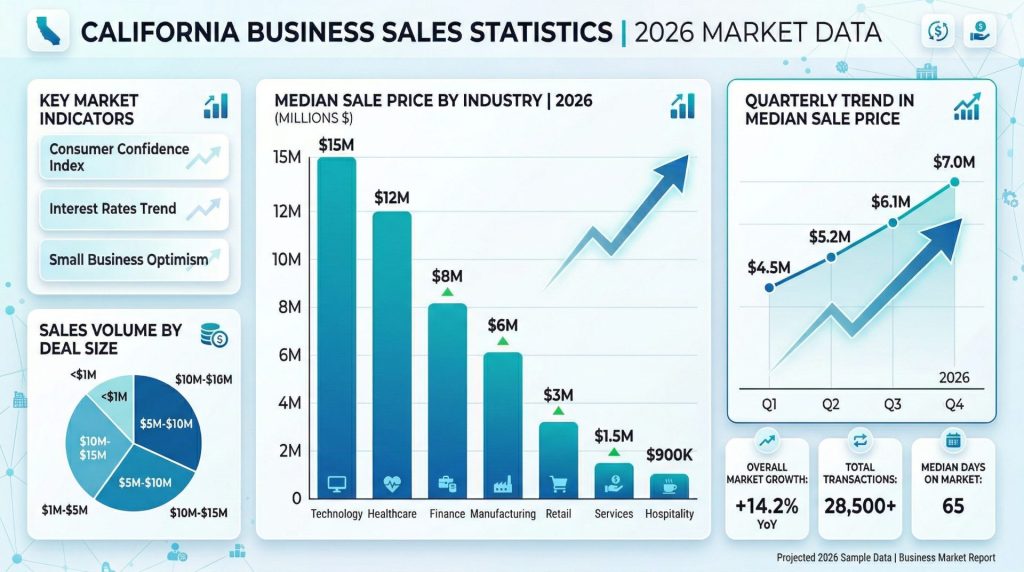
Filename: average-price-business-for-sale-california-market-data.png
| Metric | National (2025) | California Est. (2025) | YoY Change |
|---|---|---|---|
| Median Sale Price (all sizes) | $350,000 | $415,000–$440,000 | +2% |
| Median Sale Price – Manufacturing | $650,000 | $720,000–$850,000 | -7% |
| Median Sale Price – Service | $340,000 | $390,000–$480,000 | +5% |
| Median Sale Price – Retail | $250,000 | $290,000–$360,000 | -2% |
| Median Sale Price – Restaurant | $225,000 | $260,000–$320,000 | Flat |
| Average Cash Flow Multiple | 2.61x | 2.8x–3.2x | +1% |
| Average Revenue Multiple | 0.69x | 0.75x–0.90x | +2% |
| Median Days to Close | 170 days | 165–185 days | +4 days |
| Sale/Asking Price Ratio | 94% | 93%–96% | +1% |
Sources: BizBuySell 2025 Year in Review; BizBuySell Insight Report Q4 2025; California estimates based on regional market premium analysis.
No two businesses sell for the same price, even in the same industry and geography. Understanding the eight levers that buyers analyze allows you to proactively strengthen your position — and your valuation — before going to market.
📷 IMAGE PLACEHOLDER 3
Filename: average-price-business-for-sale-california-valuation-factors.png
Alt text: Infographic showing 8 key factors that determine the average price of business for sale in California including EBITDA and growth
Download URL: https://www.genspark.ai/api/files/s/vuAvrf1v?cache_control=3600
Buyers pay for where your business is going, not just where it stands today. A company showing consistent 10–15% annual revenue growth over three years commands a meaningfully higher multiple than an identically profitable business with flat top-line performance. In California's competitive M&A environment, growth trajectory can expand your EBITDA multiple by 0.5x to 1.5x above industry benchmarks. Document your growth drivers clearly — new customers, expanded territories, new service lines, or pricing power — and prepare a compelling narrative backed by clean historical data before going to market.
EBITDA — Earnings Before Interest, Taxes, Depreciation, and Amortization — is the core engine of business valuation. California businesses in the $1M–$40M revenue range typically sell at 3x to 7x normalized EBITDA, depending on sector and size. Recurring, predictable profitability driven by structural advantages commands far higher prices than lumpy project-based income. Work with your financial advisor 12–18 months before going to market to normalize your financials. Per First Page Sage's 2025 EBITDA research, businesses with strong recurring revenue can see multiples 20–40% above non-recurring peers.
If one customer represents more than 20% of your revenue, most sophisticated buyers will reduce their offer price or build a significant escrow holdback into the deal. Customer concentration is one of the most common deal-killers in mid-market California transactions. The goal is a diversified revenue base where no single customer accounts for more than 15% of total revenue. Consider pre-sale initiatives — new customer acquisition, multi-year contract conversions — to broaden your base before engaging a broker. The payoff in final sale price can be substantial, often multiples of the cost to address it.
Your sector establishes a baseline multiple; your competitive position within that sector determines whether you trade above or below it. California technology and healthcare businesses routinely trade at 4x–8x EBITDA, while food service and retail businesses more typically land in the 2x–3.5x range. Being the market leader in a defensible niche, holding proprietary technology, operating under long-term contracts, or maintaining certifications that create barriers to entry can each push your multiple meaningfully higher. Buyers pay for durability — ensure your marketing materials communicate your competitive moat explicitly and persuasively.
Owner dependence is one of the most consistent value destroyers in a business sale. If the business cannot function without you, buyers will price that risk into their offer. A business with a capable, tenured management team that operates independently commands a premium of 0.5x to 1.5x over comparable owner-dependent businesses. Start delegating critical functions 12–24 months before you plan to sell. Document processes, build accountable org structures, and demonstrate that the business's success is institutionalized — not personalized. This counterintuitive investment can add hundreds of thousands of dollars to your final price.
Predictability commands a premium in every M&A market. Businesses with subscription revenue, long-term service contracts, maintenance agreements, or membership models sell for higher multiples than those dependent on transactional sales. According to First Page Sage valuation data, recurring-revenue businesses achieve EBITDA multiples 25–35% higher than non-recurring peers in the same industry. Document contract terms, renewal rates, and average lifetime value clearly in your data room. Even modest recurring revenue components can shift buyer perception — and pricing — significantly.
Sophisticated buyers purchase a platform for future growth — not just current cash flow. If your business operates in an expanding market or has untapped geographic territories, your business becomes significantly more attractive. Frame your growth narrative with specificity: "We currently serve only the Bay Area but our model is replicable in Los Angeles, San Diego, and Phoenix" outperforms vague promises of "significant upside." Per BizBuySell data, 33% of buyers view AI-enabled businesses as more valuable — positioning technology adoption as a growth accelerant in your story can meaningfully strengthen valuation.
In California's high-cost real estate environment, lease terms have an outsized effect on business value. A business under a favorable long-term lease in a prime California market has embedded real estate value that buyers can quantify. Conversely, a lease expiring in 12 months or a facility requiring significant capital expenditure creates deal risk and price pressure. Ensure your lease has at least 3–5 years of remaining term with extension options before entering the market. Negotiate a lease extension proactively — it is one of the most tangible and straightforward ways to reduce perceived deal risk and protect your headline valuation.
The table below shows typical EBITDA multiple ranges for California businesses in the $1M–$40M revenue segment. Multiples vary based on company size, growth rate, customer concentration, and deal structure. Larger businesses within each category typically trade at the higher end of the range. Data synthesized from First Page Sage EBITDA research, BizBuySell 2025 transaction data, and regional California comparables.
📷 IMAGE PLACEHOLDER 4
Filename: average-price-business-for-sale-california-ebitda-multiples.png
Alt text: Horizontal bar chart showing EBITDA multiples by industry for businesses for sale in California ranging from 2x to 8x
Download URL: https://www.genspark.ai/api/files/s/glxbz1UT?cache_control=3600
| Industry | EBITDA Multiple Range | Key Value Driver | 2026 Trend |
|---|---|---|---|
| Technology / SaaS | 4.0x – 8.5x | Recurring revenue, ARR growth | ↑ Rising |
| Healthcare Services | 3.5x – 6.0x | Reimbursement contracts, defensible niche | ↑ Rising |
| Manufacturing | 3.0x – 5.5x | Proprietary IP, government contracts | ↓ Declining |
| Distribution / Logistics | 3.0x – 5.5x | Long-term client contracts, route density | → Stable |
| Professional Services | 2.5x – 5.0x | Recurring retainers, client tenure | ↑ Rising |
| Construction & Contracting | 2.0x – 4.5x | Backlog, recurring maintenance contracts | → Stable |
| Retail (Specialty/Niche) | 2.0x – 3.5x | Brand loyalty, e-commerce integration | ↓ Slight decline |
| Food & Beverage / Restaurant | 1.8x – 3.0x | Brand, location, multi-unit scalability | → Flat |
Understanding the average price of business for sale in California is only half the equation. Executing a professional sale process is what converts that potential value into actual proceeds at closing.
📷 IMAGE PLACEHOLDER 5
Filename: average-price-business-for-sale-california-sale-process.png
Alt text: 10-step timeline infographic for selling a business in California showing the complete process from valuation to closing
Download URL: https://www.genspark.ai/api/files/s/CpbQVrRt?cache_control=3600
📷 IMAGE PLACEHOLDER 6
Filename: average-price-business-for-sale-california-broker-checklist.png
Alt text: Broker value checklist infographic showing protection mechanisms for California business sellers including confidentiality and negotiation
Download URL: https://www.genspark.ai/api/files/s/PANXhYxX?cache_control=3600
Selling without professional representation — or with the wrong advisor — is one of the most expensive decisions a California business owner can make. Research consistently shows that businesses sold through experienced, specialized brokers achieve 20–35% higher net proceeds than owner-direct transactions. For a business with $3 million in EBITDA, that delta represents $600,000 to over $1 million in additional proceeds — multiples of any reasonable brokerage fee.
A.E. Business Brokers provides a comprehensive suite of protections: strict confidentiality protocols that safeguard your workforce and customer relationships, rigorous buyer qualification before any sensitive information is shared, access to a curated network of PE and strategic buyers actively seeking California acquisitions, expert deal structuring to optimize after-tax proceeds, and experienced negotiation to prevent the re-trades and price erosion that plague poorly managed sale processes.
📷 IMAGE PLACEHOLDER 7
Filename: average-price-business-for-sale-california-broker-benefits.png
Alt text: Infographic highlighting key benefits of using AE Business Brokers to sell a California business including higher sale price and faster closing
Download URL: https://www.genspark.ai/api/files/s/IGuoHSev?cache_control=3600
The average price of a business for sale in California varies significantly by size, industry, and profitability. California's median sits approximately 15–25% above the national median of $350,000, placing the state's broad estimate between $415,000 and $440,000 for all-size businesses. For mid-market businesses with $1M–$40M in revenue, California enterprise values typically range from $2 million to $15 million or more, depending on EBITDA margins, industry multiples, and deal structure. Contact A.E. Business Brokers for a confidential, data-driven valuation specific to your business.
Most mid-market California businesses are valued using a multiple of EBITDA or SDE (Seller's Discretionary Earnings) for smaller businesses. The multiple applied depends on your industry, revenue size, growth trajectory, customer concentration, and recurring cash flow quality. Revenue multiples (typically 0.5x–2x revenue) are used as a cross-check. Specialized sectors like technology may use ARR-based metrics. A professional business broker provides a normalized financial recast and a defensible valuation range that buyers and their advisors cannot easily challenge. Starting this process 12–18 months before your target exit date is strongly recommended.
The national median was 170 days per BizBuySell's 2025 data. In California's mid-market, well-prepared businesses with clean financials and experienced representation typically close in 6–9 months from engagement. Complex transactions involving real estate, multiple entities, or PE buyers can take 10–14 months. Underp█


Unlock a free premium market valuation provided by the nation’s leading brokerage. With our 30-year track record, $2 billion in transactions, and a global team of 25+ experts, we find your ideal buyer in under 4 months, often above market value

